Four-Stroke Engine
A four-stroke engine (also known as four-cycle) is an internal combustion engine in which the piston completes four separate strokes—intake, compression, power, and exhaust—during two separate revolutions of the engine's crankshaft, and one single thermodynamic cycle.
There are two common types of four-stroke engines. They are closely related to each other, but have major differences in design and behavior. The earliest of these to be developed is the Otto cycle engine developed in 1876 by Nikolaus August Otto in Cologne, Germany,[1] after the operation principle described by Alphonse Beau de Rochas in 1861. This engine is most often referred to as a petrol engine or gasoline engine, after the fuel that powers it.[2] The second type of four-stroke engine is the Diesel engine developed in 1893 by Rudolph Diesel, also of Germany. Diesel created his engine to improve efficiency compared with the Otto engine. There are several major differences between the Otto cycle engine and the four-stroke diesel engine. The diesel engine is made in both a two-stroke and a four-stroke version. Otto's company, Deutz AG, now primarily produces diesel engines.
The Otto cycle is named after the 1876 engine of Nikolaus A. Otto, who built a successful four-stroke engine based on the work of Jean Joseph Etienne Lenoir.[1] It was the third engine type that Otto developed. It used a sliding flame gateway for ignition of its fuel — a mixture of illuminating gas and air. After 1884, Otto also developed the magneto to create an electrical spark for ignition, which had been unreliable on the Lenoir engine.
Today, the internal combustion engine (ICE) is used in motorcycles, automobiles, boats, trucks, aircraft, ships, heavy duty machinery, and in its original intended use as stationary power both for kinetic and electrical power generation. Diesel engines are found in virtually all heavy duty applications such as trucks, ships, locomotives, power generation, and stationary power. Many of these diesel engines are two-stroke with power ratings up to 105,000 hp (78,000 kW).
The four strokes refer to intake, compression, combustion (power) and exhaust strokes that occur during two crankshaft rotations per power cycle. (Risqué slang among some automotive enthusiasts names these respectively the "suck," "squeeze," "bang" and "blow" strokes.)[3] The cycle begins at Top Dead Centre (TDC), when the piston is farthest away from the axis of the crankshaft. A stroke refers to the full travel of the piston from Top Dead Centre (TDC) to Bottom Dead Centre (BDC). (See Dead centre.)
- INTAKE or INDUCTION stroke: on the intake or induction stroke of the piston, the piston descends from the top of the cylinder to the bottom of the cylinder, increasing the volume of the cylinder. A mixture of fuel and air, or just air in a diesel engine, is forced by atmospheric (or greater) pressure into the cylinder through the intake port. The intake valve(s) then closes. The volume of air/fuel mixture that is drawn into the cylinder, relative to the maximum volume of the cylinder, is called the volumetric efficiency of the engine.
- COMPRESSION stroke: with both intake and exhaust valves closed, the piston returns to the top of the cylinder compressing the air or fuel-air mixture into the combustion chamber of the cylinder head. During the compression stroke the temperature of the air or fuel-air mixture rises by several hundred degrees.
- POWER stroke: this is the start of the second revolution of the cycle. While the piston is close to Top Dead Centre, the compressed air–fuel mixture in a gasoline engine is ignited, usually by a spark plug, or fuel is injected into a diesel engine, which ignites due to the heat generated in the air during the compression stroke. The resulting pressure from the combustion of the compressed fuel-air mixture forces the piston back down toward bottom dead centre.
- EXHAUST stroke: during the exhaust stroke, the piston once again returns to top dead centre while the exhaust valve is open. This action expels the spent fuel-air mixture through the exhaust valve(s).
Otto cycle

In testing a replica of the Lenoir engine in 1861 Otto became aware of the effects of compression on the fuel charge. In 1862, Otto attempted to produce an engine to improve on the poor efficiency and reliability of the Lenoir engine. He tried to create an engine that would compress the fuel mixture prior to ignition, but failed as that engine would run no more than a few minutes prior to its destruction. Many other engineers were trying to solve the problem, with no success.[4]
In 1864, Otto and Eugen Langen founded the first internal combustion engine production company, NA Otto and Cie (NA Otto and Company). Otto and Cie succeeded in creating a successful atmospheric engine that same year.[4] The factory ran out of space and was moved to the town of Deutz, Germany in 1869 where the company was renamed to Deutz Gasmotorenfabrik AG (The Deutz Gas Engine Manufacturing Company).[4] In 1872, Gottlieb Daimler was technical director and Wilhelm Maybach was the head of engine design. Daimler was a gunsmith who had worked on the Lenoir engine. By 1876, Otto and Langen succeeded in creating the first internal combustion engine that compressed the fuel mixture prior to combustion for far higher efficiency than any engine created to this time.[1]
Daimler and Maybach left their employ at Otto and Cie and developed the first high-speed Otto engine in 1883. In 1885, they produced the first automobile to be equipped with an Otto engine. The Petroleum Reitwagen used a hot-tube ignition system and the fuel known as Ligroin to become the world's first vehicle powered by an internal combustion engine. It used a four-stroke engine based on Otto's design. The following year Karl Benz produced a four-stroke engined automobile that is regarded as the first car. [5]
In 1884, Otto's company, then known as Gasmotorenfabrik Deutz (GFD), developed electric ignition and the carburetor. In 1890, Daimler and Maybach formed a company known as Daimler Motoren Gesellschaft. Today, that company is Daimler-Benz.
See Otto engine for more detail.
Diesel cycle
Main article: Diesel cycle

During initial development, one of the engines burst nearly killing Diesel. He persisted and finally created an engine in 1893. The high compression engine, which ignites its fuel by the heat of compression is now called the Diesel engine whether a four-stroke or two-stroke design.
The four-stroke diesel engine has been used in the majority of heavy duty applications for many decades. Chief among the reasons for this is that it uses a heavy fuel that contains more energy, requires less refinement, and is cheaper to make (although in some areas of the world diesel fuel costs more than gasoline). The most efficient Otto Cycle engines run near 30% efficiency. The Volkswagen Jetta TDI 1.9 liter engine achieves 46%. It uses an advanced design with turbocharging and direct fuel injection. Some BMW ship Diesels with ceramic insulation have exceeded 60% efficiency.[citation needed]
Both Audi and Peugeot compete in the endurance races of the Le Mans Series with cars having diesel engines. These are four-stroke turbocharged diesels that dominate largely due to fuel economy and having to make fewer stops.
Thermodynamic Analysis

exhaust (D) stroke.
Octane Requirements
Fuel octane rating
Main article: Octane rating
Otto Engines

A fuel with a low flash point may self-ignite during compression, and can also be ignited by carbon deposits left in the cylinder or head of a dirty engine. In an internal combustion engine self ignition can occur at unexpected times. During the normal operation of the engine as the fuel mixture is being compressed an electric arc is created to ignite the fuel. At low rpm this occurs close to TDC (Top Dead Centre). As engine rpm rises the spark point is moved forward so that the fuel charge can be ignited at a more efficient point in fuel charge compression to allow the fuel to start burning even while it is still being compressed. This produces more effective power based on the rising molecular density of the working medium, since this is the essence of efficiency in the compressed charge IE engine. A denser working medium (the air fuel mixture) experiences a greater heat, and therefore pressure, rises on less when its molecules are more densely packed together.
We can see this in two Otto engines designs. The non-compression engine operated at 12% efficiency. The compressed charge engine had an operating efficiency of 30%. A Diesel engine can reach as high as 70%[citation needed] (Diesel's lab engine tested at 75.6% efficiency[citation needed], VW TDI is at 46%[citation needed]).
The problem with compressed charge engines is that the temperature rise of the compressed charge can cause pre-ignition. If this occurs at the wrong time and is too energetic, it can destroy the engine. Fractions of petroleum have widely varying flash points (the temperatures at which the fuel may self-ignite). This must be taken into account in engine and fuel design.
In engines, the spark is retarded when the engine is being started, and progresses only to an appropriate amount based on engine rpm. This is determined by laboratory research. As the engine revolves faster it can accept earlier ignition since the moving flame front does not have time to be destructive.
In fuel, the tendency for the compressed fuel mixture to ignite early is limited by the chemical composition of the fuel. There are several grades of fuel to accommodate differing performance levels of engines. The fuel is altered to change its self ignition temperature. There are several ways to do this. As engines are designed with higher compression ratios the result is that pre-ignition is much more likely to occur since the fuel mixture is compressed to a higher temperature prior to deliberate ignition. The higher temperature more effectively evaporates fuels such as gasoline, and is factor in a higher compression engine being more efficient. Higher Compression ratios also mean that the distance that the piston can push to produce power is greater (which is called the Expansion ratio).
So there must be a standardized test and a standard reference system to describe how likely a fuel is to self-ignite. The octane rating is a measure of the fuel's resistance to self-ignition. A fuel with a higher numerical octane rating allows for a higher compression ratio, which extracts more energy from the fuel and more effectively converts that energy into useful work while at the same time preventing engine damage from pre-ignition. High Octane fuel is also more expensive.
Diesel Engines
Diesel engines by their nature do not have concerns with pre-ignition. They have a concern with whether or not combustion can be started. The description of how likely Diesel fuel is to ignite is called the Cetane rating. Because Diesel fuels are of low volatility, they can be very hard to start when cold. Various techniques are used to start a cold Diesel engine, the most common being the use of a glow plug.Design and engineering principles
Power output limitations

1=TDC
2=BDC
A: Intake
B: Compression
C: Power
D: Exhaust
Intake/exhaust port flow
The output power of an engine is dependent on the ability of intake (air–fuel mixture) and exhaust matter to move quickly through valve ports, typically located in the cylinder head. To increase an engine's output power, irregularities in the intake and exhaust paths, such as casting flaws, can be removed, and, with the aid of an air flow bench, the radii of valve port turns and valve seat configuration can be modified to reduce resistance. This process is called porting, and it can be done by hand or with a CNC machine.Supercharging
One way to increase engine power is to force more air into the cylinder so that more power can be produced from each power stroke. This can be done using some type of air compression device known as a supercharger, which can be powered by the engine crankshaft.Supercharging increases the power output limits of an internal combustion engine relative to its displacement. Most commonly, the supercharger is always running, but there have been designs that allow it to be cut out or run at varying speeds (relative to engine speed). Mechanically driven supercharging has the disadvantage that some of the output power is used to drive the supercharger, while power is wasted in the high pressure exhaust, as the air has been compressed twice and then gains more potential volume in the combustion but it is only expanded in one stage.
Turbocharging
A turbocharger is a supercharger that is driven by the engine's exhaust gases, by means of a turbine. It consists of a two piece, high-speed turbine assembly with one side that compresses the intake air, and the other side that is powered by the exhaust gas outflow.When idling, and at low-to-moderate speeds, the turbine produces little power from the small exhaust volume, the turbocharger has little effect and the engine operates nearly in a naturally aspirated manner. When much more power output is required, the engine speed and throttle opening are increased until the exhaust gases are sufficient to 'spin up' the turbocharger's turbine to start compressing much more air than normal into the intake manifold.
Turbocharging allows for more efficient engine operation because it is driven by exhaust pressure that would otherwise be (mostly) wasted, but there is a design limitation known as turbo lag. The increased engine power is not immediately available due to the need to sharply increase engine RPM, to build up pressure and to spin up the turbo, before the turbo starts to do any useful air compression. The increased intake volume causes increased exhaust and spins the turbo faster, and so forth until steady high power operation is reached. Another difficulty is that the higher exhaust pressure causes the exhaust gas to transfer more of its heat to the mechanical parts of the engine.
Rod and piston-to-stroke ratio
The rod-to-stroke ratio is the ratio of the length of the connecting rod to the length of the piston stroke. A longer rod reduces sidewise pressure of the piston on the cylinder wall and the stress forces, increasing engine life. It also increases the cost and engine height and weight.A "square engine" is an engine with a bore diameter equal to its stroke length. An engine where the bore diameter is larger than its stroke length is an oversquare engine, conversely, an engine with a bore diameter that is smaller than its stroke length is an undersquare engine.
Valve train
The valves are typically operated by a camshaft rotating at half the speed of the crankshaft. It has a series of cams along its length, each designed to open a valve during the appropriate part of an intake or exhaust stroke. A tappet between valve and cam is a contact surface on which the cam slides to open the valve. Many engines use one or more camshafts “above” a row (or each row) of cylinders, as in the illustration, in which each cam directly actuates a valve through a flat tappet. In other engine designs the camshaft is in the crankcase, in which case each cam contacts a push rod, which contacts a rocker arm that opens a valve. The overhead cam design typically allows higher engine speeds because it provides the most direct path between cam and valve.Valve clearance
Valve clearance refers to the small gap between a valve lifter and a valve stem that ensures that the valve completely closes. On engines with mechanical valve adjustment, excessive clearance causes noise from the valve train. A too small valve clearance can result in the valves not closing properly, this results in a loss of performance and possibly overheating of exhaust valves. Typically, the clearance must be readjusted each 20,000 miles (32,000 km) with a feeler gauge.Most modern production engines use hydraulic lifters to automatically compensate for valve train component wear. Dirty engine oil may cause lifter failure.
Energy balance
Otto engines are about 30% efficient; in other words, 30% of the energy generated by combustion is converted into useful rotational energy at the output shaft of the engine, while the remainder being losses due to waste heat, friction and engine accessories.[7] There are a number of ways to recover some of the energy lost to waste heat. The use of a Turbocharger in Diesel engines is very effective by boosting incoming air pressure and in effect provides the same increase in performance as having more displacement. The Mack Truck company, decades ago, developed a turbine system that converted waste heat into kinetic energy that it fed back into the engine's transmission. In 2005, BMW announced the development of the turbosteamer, a two stage heat recovery system similar to the Mack system that recovers 80% of the energy in the exhaust gas and raises the efficiency of an Otto engine by 15%.[8] By contrast, a six-stroke engine may convert more than 50% of the energy of combustion into useful rotational energy.Modern engines are often intentionally built to be slightly less efficient than they could otherwise be. This is necessary for emission controls such as exhaust gas recirculation and catalytic converters that reduce smog and other atmospheric pollutants. Reductions in efficiency may be counteracted with an engine control unit using lean burn techniques.[9]
In the United States, the Corporate Average Fuel Economy mandates that vehicles must achieve an average of 35.5 miles per gallon (mpg) compared to the current standard of 25 mpg. As automakers look to meet these standards by 2016, new ways of engineering the traditional internal combustion engine (ICE) could have to be considered. Some potential solutions to increase fuel efficiency to meet new mandates include firing after the piston is farthest from the crankshaft, known as top dead centre, and applying the Miller cycle. Together, this redesign could significantly reduce fuel consumption and NOx emissions.


Starting position, intake stroke, and compression stroke.


Ignition of fuel, power stroke, and exhaust stroke.
Two-Cycle Engine
A two-stroke, two-cycle, or two-cycle engine is a type of internal combustion engine which completes a power cycle in only one crankshaft revolution and with two strokes, or up and down movements, of the piston in comparison to a "four-stroke engine",
which uses four strokes to do so. This is accomplished by the end of
the combustion stroke and the beginning of the compression stroke
happening simultaneously and performing the intake and exhaust (or scavenging) functions at the same time.
Two-stroke engines often provide high power-to-weight ratio,
usually in a narrow range of rotational speeds called the "power band",
and, compared to 4-stroke engines, have a greatly reduced number of
moving parts, are more compact and significantly lighter.
The first commercial two-stroke engine involving in-cylinder compression is attributed to Scottish engineer Dugald Clerk,
who in 1881 patented his design, his engine having a separate charging
cylinder. The crankcase-scavenged engine, employing the area below the
piston as a charging pump, is generally credited to Englishman Joseph Day.
Gasoline (spark ignition) versions are particularly useful in lightweight (portable) applications such as chainsaws and small, lightweight and racing motorcycles, and the concept is also used in diesel compression ignition
engines in large and weight insensitive applications, such as ships,
locomotives and electricity generation. The heat transfer from the
engine to the cooling system is less in a two-stroke engine than in a
traditional four-stroke, a fact that adds to the overall engine
efficiency.
Applications
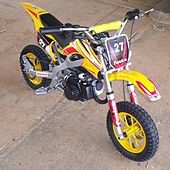
 A two-stroke minibike

Lateral view of a two-stroke Forty series British Seagull outboard engine, the serial number dates it to 1954/1955

A two-stroke engine, in this case with an expansion chamber illustrates the effect of a reflected pressure wave on the fuel charge. This feature is essential for maximum charge pressure (volumetric efficiency) and fuel efficiency. It is used on most high-performance engine designs.

A Cox Babe Bee 0.049 cubic inch (0.8 cubic cm) reed valve engine, disassembled, uses glow plug ignition. The mass is 64 grams.
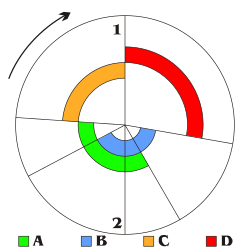
The Two-stroke cycle
1=TDC
2=BDC
A: intake/scavenging
B: Exhaust
C: Compression
D: Expansion (power)

The Uniflow Two-stroke cycle
1=TDC (Diesel injection is usually initiated at 4° BTDC)
2=BDC
A: Intake (effective scavenging ≈ 135°-225°; necessarily symmetric about BDC)
B: Exhaust (not necessarily symmetric)
C: Compression (not necessarily symmetric)
D: Expansion (power; not necessarily symmetric)


The two-stroke petrol engine was very popular throughout the
19th-20th century in motorcycles and small-engined devices, such as chainsaws and outboard motors,
and was also used in some cars, a few tractors and many ships. Part of
their appeal was their simple design (and resulting low cost) and often
high power-to-weight ratio.
The lower cost to rebuild and maintain made the two stroke engine
incredibly popular, until for the USA their EPA mandated more stringent
emission controls in 1978 (taking effect in 1980) and in 2004 (taking
effect in 2005 and 2010). The industry largely responded by switching to
four-stroke petrol engines, which emit less pollution.[1] Most small designs use petroil
lubrication, with the oil being burned in the combustion chamber,
causing "blue smoke" and other types of exhaust pollution. This is a
major reason why two-stroke engines were replaced by four-stroke engines
in many applications.
Two-stroke petrol (gas) engines continue to be commonly used in high-power, handheld applications such as string trimmers and chainsaws.
The light overall weight, and light-weight spinning parts give
important operational and even safety advantages. For example, a
four-stroke engine to power a chainsaw operating in any position would be much more expensive and complex than a two-stroke engine that uses a gasoline-oil mixture.
These engines are still used for small, portable, or specialized machine applications such as outboard motors, high-performance, small-capacity motorcycles, mopeds, underbones, scooters, tuk-tuks, snowmobiles, karts, ultralights, model airplanes (and other model vehicles) and lawnmowers and dirt bikes.
The two-stroke cycle is also used in many diesel engines,
most notably large industrial and marine engines, as well as some
trucks and heavy machinery, but two-stroke diesels don't burn their
lubricating oil and don't have the emission problems of two stroke
petrol / gasoline engines.
A number of mainstream automobile manufacturers have used two-stroke engines in the past, including the Swedish Saab and German manufacturers DKW and Auto-Union. The Japanese manufacturer Suzuki did the same in the 1970s.[2] Production of two-stroke cars ended in the 1980s in the West, but Eastern Bloc countries continued until around 1991, with the Trabant and Wartburg in East Germany. Lotus of Norfolk, UK, has a prototype direct-injection two-stroke engine intended for alcohol fuels called the Omnivore[3][4] which it is demonstrating in a version of the Exige.[5] As this uses direct fuel injection it can be made not to use oil or crankcase compression, much like a 2T diesel.
Different two-stroke design types

Although the principles remain the same, the mechanical details of
various two-stroke engines differ depending on the type. The design
types vary according to the method of introducing the charge to the
cylinder, the method of scavenging the cylinder (exchanging burnt exhaust for fresh mixture) and the method of exhausting the cylinder.
Piston-controlled inlet port
Piston
port is the simplest of the designs and the most common in small 2
stroke motorcycles. All functions are controlled solely by the piston
covering and uncovering the ports as it moves up and down in the
cylinder. In the 1970s Yamaha worked out some basic principles for this
system. They found that, in general, widening an exhaust port increases
the power by the same amount as raising the port, but the power band
does not narrow as it does when the port is raised. However, there is a
mechanical limit to the width of a single exhaust port, at about 62% of
the bore diameter for reasonable ring life. Beyond this, the rings will
bulge into the exhaust port and wear quickly. A maximum is 70% of bore
width is possible in racing engines, where rings are changed every few
races. Intake duration is between 120 and 160 degrees. Transfer port
time is set at a minimum of 26 degrees. The strong low pressure pulse of
a racing 2-stroke expansion chamber can drop the pressure to -7 PSI
when the piston is at bottom dead centre, and the transfer ports nearly
wide open. One of the reasons for high gas consumption in 2-strokes is
that some of the incoming pressurized fuel/air mixture is forced across
the top of the piston, where it has a cooling action, and straight out
the exhaust pipe. An expansion chamber with a strong reverse pulse will
stop this out-going flow.[6] A fundamental difference from typical four-stroke engines is that the crankcase is sealed, and forms part of the induction process in gasoline and hot bulb engines. Diesel engines have mostly a Roots blower or piston pump for scavenging.
Reed inlet valve
Main article: Reed valve

The reed valve is a simple but highly effective form of check valve
commonly fitted in the intake tract of the piston-controlled port. They
allow asymmetric intake of the fuel charge, improving power and
economy, while widening the power band. They are widely used in ATVs and
marine outboard engines.
Rotary inlet valve
The intake pathway is opened and closed by a rotating member. A
familiar type sometimes seen on small motorcycles is a slotted disk
attached to the crankshaft which covers and uncovers an opening in the end of the crankcase, allowing charge to enter during one portion of the cycle.
Another form of rotary inlet valve used on two-stroke engines employs
two cylindrical members with suitable cutouts arranged to rotate one
within the other - the inlet pipe having passage to the crankcase only
when the two cutouts coincide. The crankshaft itself may form one of the
members, as in most glow plug model engines. In another embodiment, the
crank disc is arranged to be a close-clearance fit in the crankcase,
and is provided with a cutout which lines up with an inlet passage in
the crankcase wall at the appropriate time, as in the Vespa motor scooter.
The advantage of a rotary valve
is it enables the two-stroke engine's intake timing to be asymmetrical,
which is not possible with piston port type engines. The piston port
type engine's intake timing opens and closes before and after top dead
center at the same crank angle, making it symmetrical, whereas the
rotary valve allows the opening to begin earlier and close earlier.
Rotary valve engines can be tailored to deliver power over a wider
speed range or higher power over a narrower speed range than either
piston port or reed valve engine. Where a portion of the rotary valve is
a portion of the crankcase itself, it is particularly important that no
wear is allowed to take place.
Cross-flow-scavenged

In a cross-flow engine, the transfer and exhaust ports are on opposite sides of the cylinder, and a deflector
on the top of the piston directs the fresh intake charge into the upper
part of the cylinder, pushing the residual exhaust gas down the other
side of the deflector and out the exhaust port.[7]
The deflector increases the piston's weight and exposed surface area,
affecting piston cooling and also making it difficult to achieve an
efficient combustion chamber shape. This design has been superseded
since the 1960s by the loop scavenging method (below), especially for
motorbikes, although for smaller or slower engines, such as motor
mowers, the cross-flow-scavenged design can be an acceptable approach.
Loop-scavenged

1=TDC
2=BDC
A: intake/scavenging
B: Exhaust
C: Compression
D: Expansion (power)
Main article: Schnuerle porting
This method of scavenging uses carefully shaped and positioned
transfer ports to direct the flow of fresh mixture toward the combustion
chamber as it enters the cylinder. The fuel/air mixture strikes the cylinder head, then follows the curvature of the combustion chamber, and then is deflected downward.
This not only prevents the fuel/air mixture from traveling directly
out the exhaust port, but also creates a swirling turbulence which
improves combustion efficiency, power and economy. Usually, a piston
deflector is not required, so this approach has a distinct advantage
over the cross-flow scheme (above).
Often referred to as "Schnuerle" (or "Schnürl") loop scavenging after
the German inventor of an early form in the mid-1920s, it became widely
adopted in that country during the 1930s and spread further afield
after World War II.
Loop scavenging is the most common type of fuel/air mixture transfer
used on modern two-stroke engines. Suzuki was one of the first
manufacturers outside of Europe to adopt loop-scavenged two-stroke
engines. This operational feature was used in conjunction with the
expansion chamber exhaust developed by German motorcycle manufacturer,
MZ and Walter Kaaden.
Loop scavenging, disc valves and expansion chambers worked in a
highly coordinated way to significantly increase the power output of
two-stroke engines, particularly from the Japanese manufacturers Suzuki,
Yamaha and Kawasaki. Suzuki and Yamaha enjoyed success in grand Prix
motorcycle racing in the 1960s due in no small way to the increased
power afforded by loop scavenging.
An additional benefit of loop scavenging was the piston could be made
nearly flat or slightly dome shaped, which allowed the piston to be
appreciably lighter and stronger, and consequently to tolerate higher
engine speeds. The "flat top" piston also has better thermal properties
and is less prone to uneven heating, expansion, piston seizures,
dimensional changes and compression losses.
SAAB built 750 and 850 cc 3-cylinder engines based on a DKW design
that proved reasonably successful employing loop charging. The original
SAAB 92 had a two-cylinder engine of comparatively low efficiency. At
cruising speed, reflected wave exhaust port blocking occurred at too low
a frequency. Using the asymmetric three-port exhaust manifold employed
in the identical DKW engine improved fuel economy.
The 750 cc standard engine produced 36 to 42 hp, depending on the
model year. The Monte Carlo Rally variant, 750 cc (with a filled
crankshaft for higher base compression), generated 65 hp. An 850 cc
version was available in the 1966 SAAB Sport (a standard trim model in
comparison to the deluxe trim of the Monte Carlo). Base compression
comprises a portion of the overall compression ratio of a two-stroke
engine. Work published at SAE in 2012 points that loop scavenging is
under every circumstance more efficient than uniflow scavenging.
Uniflow-scavenged

1=TDC (Diesel injection is usually initiated at 4° BTDC)
2=BDC
A: Intake (effective scavenging ≈ 135°-225°; necessarily symmetric about BDC)
B: Exhaust (not necessarily symmetric)
C: Compression (not necessarily symmetric)
D: Expansion (power; not necessarily symmetric)
In a uniflow engine, the mixture, or "charge air" in the case of a
diesel, enters at one end of the cylinder controlled by the piston and
the exhaust exits at the other end controlled by an exhaust valve or
piston. The scavenging gas-flow is therefore in one direction only,
hence the name uniflow. The valved arrangement is common in on-road,
off-road and stationary two-stroke engines (Detroit Diesel), certain small marine two-stroke engines (Gray Marine), certain railroad two-stroke diesel locomotives (Electro-Motive Diesel) and large marine two-stroke main propulsion engines (Wärtsilä). Ported types are represented by the opposed piston design in which there are two pistons in each cylinder, working in opposite directions such as the Junkers Jumo and Napier Deltic.[8] The once-popular split-single
design falls into this class, being effectively a folded uniflow. With
advanced angle exhaust timing, uniflow engines can be supercharged with a
crankshaft-driven (piston [9] or Roots) blower.
The latest invention, called the Reversed Uniflow two-stroke engine,
has a large intake valve for compressed intake air without fuel-oil
mixture. Direct fuel injection is to be used for gasoline or diesel
fuel, pending intake air pressure. This engine will work on the Miller
cycle. US Patent #6889636.
Stepped piston engine
 |
This section does not cite any references or sources. (September 2010) |
The piston of this engine is "top-hat" shaped; the upper section
forms the regular cylinder, and the lower section performs a scavenging
function. The units run in pairs, with the lower half of one piston
charging an adjacent combustion chamber.
This system is still partially dependent on total loss lubrication
(for the upper part of the piston), the other parts being sump
lubricated with cleanliness and reliability benefits. The piston weight
is only about 20% heavier than a loop-scavenged piston because skirt
thicknesses can be less. Bernard Hooper Engineering Ltd. (BHE) is one of
the more recent engine developers using this approach.[10]
Power valve systems
|
This section does not cite any references or sources. (September 2010) |
Main article: Two-stroke power valve system
Many modern two-stroke engines employ a power valve system.
The valves are normally in or around the exhaust ports. They work in
one of two ways: either they alter the exhaust port by closing off the
top part of the port, which alters port timing, such as Ski-doo R.A.V.E, Yamaha YPVS, Honda RC-Valve, Kawasaki K.I.P.S., Cagiva C.T.S. or Suzuki AETC systems, or by altering the volume of the exhaust, which changes the resonant frequency of the expansion chamber, such as the Honda
V-TACS system. The result is an engine with better low-speed power
without sacrificing high-speed power. However as power valves are in the
hot gas flow they need regular maintenance to perform well.
Direct injection
Main article: Gasoline direct injection#In two-stroke engines
Direct injection has considerable advantages in two-stroke engines,
eliminating some of the waste and pollution caused by carbureted
two-strokes where a proportion of the fuel/air mixture entering the
cylinder goes directly out, unburned, through the exhaust port. Two
systems are in use, low-pressure air-assisted injection, and high
pressure injection.
Since the fuel does not pass through the crankcase, a separate source of lubrication is needed.
Two-stroke diesel engine

|
This section does not cite any references or sources. (September 2010) |
Main article: Two-stroke diesel engine
Diesel engines rely solely on the heat of compression for ignition. In the case of Schnuerle ported and loop-scavenged engines, intake and exhaust happens via piston-controlled ports. A uniflow diesel engine takes in air via scavenge ports, and exhaust gases exit through an overhead poppet valve. Two-stroke diesels are all scavenged by forced induction. Some designs use a mechanically driven Roots blower,
whilst marine diesel engines normally use exhaust-driven turbochargers,
with electrically-driven auxiliary blowers for low-speed operation when
exhaust turbochargers are unable to deliver enough air.
Marine two-stroke diesel engines directly coupled to the propeller
are able to start and run in either direction as required. The fuel
injection and valve timing is mechanically readjusted by using a
different set of cams on the camshaft. Thus, the engine can be run in
reverse to move the vessel backwards.
Lubrication
|
This section does not cite any references or sources. (September 2010) |
Most small petrol two-stroke engines cannot be lubricated by oil contained in their crankcase and sump, since the crankcase
is already being used to pump fuel-air mixture into the cylinder.
Traditionally, the moving parts (both rotating crankshaft and sliding
piston) were lubricated by a premixed fuel-oil mixture (at a ratio
between 16:1 and 100:1). As late as the 1960s, petrol stations would
often have a separate pump to deliver such a premix fuel to motorcycles.
Even then, in many cases, the rider would carry a bottle of their own
two-stroke oil. Taking care to close the fuel-tap first, he or she would
meter in a little oil (using the cap of the bottle) and then put in the
petrol, this action mixing the two liquids. Two-stroke oils which
became available worldwide in the 1970s are specifically designed to mix
with petrol and be burnt in the combustion chamber without leaving
undue unburnt oil or ash. This led to a marked reduction in spark plug
fouling, which had been a factor in two-stroke engines previously.
Modern two-stroke engines pump lubrication from a separate tank of
two stroke oil. The supply of this oil is controlled by the throttle
position. The technology is referred to as auto-lube.
This is still a total-loss system with the oil being burnt the same as
in the older system, but at a lower and more economical rate. It is also
cleaner, reducing the problem of oil-fouling of the spark-plugs and
coke formation in the cylinder and the exhaust. Two-stroke engines still
using premix are hand-held two-stroke devices, such as chainsaws (which
must operate in any attitude), the majority of model engines, British Seagull outboard motors, and some off-road motorcycles.
All two-stroke engines running on a petrol/oil mix will suffer oil
starvation if forced to rotate at speed with the throttle closed, e.g.
motorcycles descending long hills and perhaps when decelerating
gradually from high speed by changing down through the gears. Two-stroke
cars (such as those that were popular in Eastern Europe in mid-20th
century) were in particular danger and were usually fitted with freewheel mechanisms in the powertrain, allowing the engine to idle when the throttle was closed, requiring the use of the brakes in all slowing situations.
Large two-stroke engines, including diesels, normally use a sump
lubrication system similar to four-stroke engines. The cylinder must
still be pressurized, but this is not done from the crankcase, but by an
ancillary Roots-type blower or a specialized turbocharger
(usually a turbo-compressor system) which has a "locked" compressor for
starting (and during which it is powered by the engine's crankshaft),
but which is "unlocked" for running (and during which it is powered by
the engine's exhaust gases flowing through the turbine).
Two-stroke reversibility
For the purpose of this discussion, it is convenient to think in
motorcycle terms, where the exhaust pipe faces into the cooling air
stream, and the crankshaft commonly spins in the same axis and direction
as do the wheels i.e. "forward". Some of the considerations discussed
here apply to four-stroke engines (which cannot reverse their direction
of rotation without considerable modification), almost all of which spin
forward, too.
Regular gasoline two-stroke engines will run backwards for short
periods and under light load with little problem, and this has been used
to provide a reversing facility in microcars, such as the Messerschmitt KR200,
that lacked reverse gearing. Where the vehicle has electric starting,
the motor will be turned off and restarted backwards by turning the key
in the opposite direction. Two-stroke golf carts have used a similar kind of system. Traditional flywheel magnetos
(using contact-breaker points, but no external coil) worked equally
well in reverse because the cam controlling the points is symmetrical,
breaking contact before TDC
equally well whether running forwards or backwards. Reed-valve engines
will run backwards just as well as piston-controlled porting, though
rotary valve engines have asymmetrical inlet timing and will not run
very well.
There are serious disadvantages to running any engine backwards under
load for any length of time, and some of these reasons are general,
applying equally to both two-stroke and four-stroke engines. Some of
this disadvantage is intrinsic, unavoidable even in the case of a
complete re-design. The problem comes about because in "forwards"
running the major thrust face of the piston is on the back face of the
cylinder which, in a two-stroke particularly, is the coolest and best
lubricated part. The forward face of the piston is less well-suited to
be the major thrust face since it covers and uncovers the exhaust port
in the cylinder, the hottest part of the engine, where piston
lubrication is at its most marginal. The front face of the piston is
also more vulnerable since the exhaust port, the largest in the engine,
is in the front wall of the cylinder. Piston skirts and rings risk being
extruded into this port, so it is always better to have them pressing
hardest on the back wall (where there are only the transfer ports) and
there is good support. In some engines, the small end
is offset to reduce thrust in the intended rotational direction and the
forward face of the piston has been made thinner and lighter to
compensate - but when running backwards, this weaker forward face
suffers increased mechanical stress it was not designed to resist.[11]
Large two-stroke ship diesels are sometimes made to be reversible.
Like four-stroke ship engines (some of which are also reversible) they
use mechanically-operated valves, so require additional camshaft
mechanisms.
On top of other considerations, the oil-pump of a modern two-stroke
may not work in reverse, in which case the engine will suffer oil
starvation within a short time. Running a motorcycle engine backwards is
relatively easy to initiate, and in rare cases, can be triggered by a
back-fire. It is not advisable.
Model airplane engines with reed-valves can be mounted in either tractor or pusher
configuration without needing to change the propeller. These motors are
compression ignition, so there are no ignition timing issues and little
difference between running forward and running backward.

Tidak ada komentar:
Posting Komentar