Sabtu, 07 September 2013

ENGINE GASOLINE SYSTEM

ENGINE GASOLINE SYSTEM
Four-Stroke Engine
A four-stroke engine (also known as four-cycle) is an internal combustion engine in which the piston completes four separate strokes—intake, compression, power, and exhaust—during two separate revolutions of the engine's crankshaft, and one single thermodynamic cycle.
There are two common types of four-stroke engines. They are closely related to each other, but have major differences in design and behavior. The earliest of these to be developed is the Otto cycle engine developed in 1876 by Nikolaus August Otto in Cologne, Germany,[1] after the operation principle described by Alphonse Beau de Rochas in 1861. This engine is most often referred to as a petrol engine or gasoline engine, after the fuel that powers it.[2] The second type of four-stroke engine is the Diesel engine developed in 1893 by Rudolph Diesel, also of Germany. Diesel created his engine to improve efficiency compared with the Otto engine. There are several major differences between the Otto cycle engine and the four-stroke diesel engine. The diesel engine is made in both a two-stroke and a four-stroke version. Otto's company, Deutz AG, now primarily produces diesel engines.
The Otto cycle is named after the 1876 engine of Nikolaus A. Otto, who built a successful four-stroke engine based on the work of Jean Joseph Etienne Lenoir.[1] It was the third engine type that Otto developed. It used a sliding flame gateway for ignition of its fuel — a mixture of illuminating gas and air. After 1884, Otto also developed the magneto to create an electrical spark for ignition, which had been unreliable on the Lenoir engine.
Today, the internal combustion engine (ICE) is used in motorcycles, automobiles, boats, trucks, aircraft, ships, heavy duty machinery, and in its original intended use as stationary power both for kinetic and electrical power generation. Diesel engines are found in virtually all heavy duty applications such as trucks, ships, locomotives, power generation, and stationary power. Many of these diesel engines are two-stroke with power ratings up to 105,000 hp (78,000 kW).
The four strokes refer to intake, compression, combustion (power) and exhaust strokes that occur during two crankshaft rotations per power cycle. (Risqué slang among some automotive enthusiasts names these respectively the "suck," "squeeze," "bang" and "blow" strokes.)[3] The cycle begins at Top Dead Centre (TDC), when the piston is farthest away from the axis of the crankshaft. A stroke refers to the full travel of the piston from Top Dead Centre (TDC) to Bottom Dead Centre (BDC). (See Dead centre.)
  1. INTAKE or INDUCTION stroke: on the intake or induction stroke of the piston, the piston descends from the top of the cylinder to the bottom of the cylinder, increasing the volume of the cylinder. A mixture of fuel and air, or just air in a diesel engine, is forced by atmospheric (or greater) pressure into the cylinder through the intake port. The intake valve(s) then closes. The volume of air/fuel mixture that is drawn into the cylinder, relative to the maximum volume of the cylinder, is called the volumetric efficiency of the engine.
  2. COMPRESSION stroke: with both intake and exhaust valves closed, the piston returns to the top of the cylinder compressing the air or fuel-air mixture into the combustion chamber of the cylinder head. During the compression stroke the temperature of the air or fuel-air mixture rises by several hundred degrees.
  3. POWER stroke: this is the start of the second revolution of the cycle. While the piston is close to Top Dead Centre, the compressed air–fuel mixture in a gasoline engine is ignited, usually by a spark plug, or fuel is injected into a diesel engine, which ignites due to the heat generated in the air during the compression stroke. The resulting pressure from the combustion of the compressed fuel-air mixture forces the piston back down toward bottom dead centre.
  4. EXHAUST stroke: during the exhaust stroke, the piston once again returns to top dead centre while the exhaust valve is open. This action expels the spent fuel-air mixture through the exhaust valve(s).
History

Otto cycle


An Otto Engine from 1920s US Manufacture
Nikolaus August Otto as a young man was a traveling salesman for a grocery concern. In his travels he encountered the internal combustion engine built in Paris by Belgian expatriate Jean Joseph Etienne Lenoir. In 1860, Lenoir successfully created a double-acting engine that ran on illuminating gas at 4% efficiency. The 18 litre Lenoir Engine produced only 2 horsepower. The Lenoir engine ran on illuminating gas made from coal, which had been developed in Paris by Philip Lebon.[1][4]
In testing a replica of the Lenoir engine in 1861 Otto became aware of the effects of compression on the fuel charge. In 1862, Otto attempted to produce an engine to improve on the poor efficiency and reliability of the Lenoir engine. He tried to create an engine that would compress the fuel mixture prior to ignition, but failed as that engine would run no more than a few minutes prior to its destruction. Many other engineers were trying to solve the problem, with no success.[4]
In 1864, Otto and Eugen Langen founded the first internal combustion engine production company, NA Otto and Cie (NA Otto and Company). Otto and Cie succeeded in creating a successful atmospheric engine that same year.[4] The factory ran out of space and was moved to the town of Deutz, Germany in 1869 where the company was renamed to Deutz Gasmotorenfabrik AG (The Deutz Gas Engine Manufacturing Company).[4] In 1872, Gottlieb Daimler was technical director and Wilhelm Maybach was the head of engine design. Daimler was a gunsmith who had worked on the Lenoir engine. By 1876, Otto and Langen succeeded in creating the first internal combustion engine that compressed the fuel mixture prior to combustion for far higher efficiency than any engine created to this time.[1]
Daimler and Maybach left their employ at Otto and Cie and developed the first high-speed Otto engine in 1883. In 1885, they produced the first automobile to be equipped with an Otto engine. The Petroleum Reitwagen used a hot-tube ignition system and the fuel known as Ligroin to become the world's first vehicle powered by an internal combustion engine. It used a four-stroke engine based on Otto's design. The following year Karl Benz produced a four-stroke engined automobile that is regarded as the first car. [5]
In 1884, Otto's company, then known as Gasmotorenfabrik Deutz (GFD), developed electric ignition and the carburetor. In 1890, Daimler and Maybach formed a company known as Daimler Motoren Gesellschaft. Today, that company is Daimler-Benz.
See Otto engine for more detail.

Diesel cycle


Audi Diesel R15 at Le Mans
The diesel engine is a technical refinement of the 1876 Otto Cycle engine. Where Otto had realized in 1861 that the efficiency of the engine could be increased by first compressing the fuel mixture prior to its ignition, Rudolph Diesel wanted to develop a more efficient type of engine that could run on much heavier fuel. The Lenoir, Otto Atmospheric, and Otto Compression engines (both 1861 and 1876) were designed to run on Illuminating Gas (coal gas). With the same motivation as Otto, Diesel wanted to create an engine that would give small industrial concerns their own power source to enable them to compete against larger companies, and like Otto to get away from the requirement to be tied to a municipal fuel supply. Like Otto, it took more than a decade to produce the high compression engine that could self-ignite fuel sprayed into the cylinder. Diesel used an air spray combined with fuel in his first engine.
During initial development, one of the engines burst nearly killing Diesel. He persisted and finally created an engine in 1893. The high compression engine, which ignites its fuel by the heat of compression is now called the Diesel engine whether a four-stroke or two-stroke design.
The four-stroke diesel engine has been used in the majority of heavy duty applications for many decades. Chief among the reasons for this is that it uses a heavy fuel that contains more energy, requires less refinement, and is cheaper to make (although in some areas of the world diesel fuel costs more than gasoline). The most efficient Otto Cycle engines run near 30% efficiency. The Volkswagen Jetta TDI 1.9 liter engine achieves 46%. It uses an advanced design with turbocharging and direct fuel injection. Some BMW ship Diesels with ceramic insulation have exceeded 60% efficiency.[citation needed]
Both Audi and Peugeot compete in the endurance races of the Le Mans Series with cars having diesel engines. These are four-stroke turbocharged diesels that dominate largely due to fuel economy and having to make fewer stops.

Thermodynamic Analysis


The idealized four-stroke Otto cycle p-V diagram: the  intake (A)  stroke is performed by an isobaric expansion, followed by the  compression (B)  stroke, performed by an adiabatic compression. Through the combustion of fuel an isochoric process is produced, followed by an adiabatic expansion, characterizing the  power (C)  stroke. The cycle is closed by an isochoric process and an isobaric compression, characterizing the
 exhaust (D)  stroke.
The thermodynamic analysis of the actual four-stroke or two-stroke cycles is not a simple task. However, the analysis can be simplified significantly if air standard assumptions[6] are utilized. The resulting cycle, which closely resembles the actual operating conditions, is the Otto cycle.

Octane Requirements

Fuel octane rating

Otto Engines


A Refractory Tower showing the differing weights of various products.
The fuels used in four-cycle engines are typically fractions of crude oil, coal tar, oil shale, or sands produced in a process called Petroleum Cracking. The ignition temperature of the fuel that is refracted is related to its weight. It is separated by being heated and is extracted at different heights in the refractory tower. The higher the fuel vapor rises in the tower, the lower its weight and the less energy it contains. In refracting petroleum, there is a standard weight of fuels and products that are withdrawn and associated with a specific extracted material. Gasoline is a light refractory product and is called a light fraction. As a light fraction it has a relatively low flash point (that is the temperature at which it starts to burn when mixed with an oxidizer).
A fuel with a low flash point may self-ignite during compression, and can also be ignited by carbon deposits left in the cylinder or head of a dirty engine. In an internal combustion engine self ignition can occur at unexpected times. During the normal operation of the engine as the fuel mixture is being compressed an electric arc is created to ignite the fuel. At low rpm this occurs close to TDC (Top Dead Centre). As engine rpm rises the spark point is moved forward so that the fuel charge can be ignited at a more efficient point in fuel charge compression to allow the fuel to start burning even while it is still being compressed. This produces more effective power based on the rising molecular density of the working medium, since this is the essence of efficiency in the compressed charge IE engine. A denser working medium (the air fuel mixture) experiences a greater heat, and therefore pressure, rises on less when its molecules are more densely packed together.
We can see this in two Otto engines designs. The non-compression engine operated at 12% efficiency. The compressed charge engine had an operating efficiency of 30%. A Diesel engine can reach as high as 70%[citation needed] (Diesel's lab engine tested at 75.6% efficiency[citation needed], VW TDI is at 46%[citation needed]).
The problem with compressed charge engines is that the temperature rise of the compressed charge can cause pre-ignition. If this occurs at the wrong time and is too energetic, it can destroy the engine. Fractions of petroleum have widely varying flash points (the temperatures at which the fuel may self-ignite). This must be taken into account in engine and fuel design.
In engines, the spark is retarded when the engine is being started, and progresses only to an appropriate amount based on engine rpm. This is determined by laboratory research. As the engine revolves faster it can accept earlier ignition since the moving flame front does not have time to be destructive.
In fuel, the tendency for the compressed fuel mixture to ignite early is limited by the chemical composition of the fuel. There are several grades of fuel to accommodate differing performance levels of engines. The fuel is altered to change its self ignition temperature. There are several ways to do this. As engines are designed with higher compression ratios the result is that pre-ignition is much more likely to occur since the fuel mixture is compressed to a higher temperature prior to deliberate ignition. The higher temperature more effectively evaporates fuels such as gasoline, and is factor in a higher compression engine being more efficient. Higher Compression ratios also mean that the distance that the piston can push to produce power is greater (which is called the Expansion ratio).
So there must be a standardized test and a standard reference system to describe how likely a fuel is to self-ignite. The octane rating is a measure of the fuel's resistance to self-ignition. A fuel with a higher numerical octane rating allows for a higher compression ratio, which extracts more energy from the fuel and more effectively converts that energy into useful work while at the same time preventing engine damage from pre-ignition. High Octane fuel is also more expensive.

Diesel Engines

Diesel engines by their nature do not have concerns with pre-ignition. They have a concern with whether or not combustion can be started. The description of how likely Diesel fuel is to ignite is called the Cetane rating. Because Diesel fuels are of low volatility, they can be very hard to start when cold. Various techniques are used to start a cold Diesel engine, the most common being the use of a glow plug.

Design and engineering principles

Power output limitations


The four-stroke cycle
1=TDC
2=BDC
 A: Intake 
 B: Compression 
 C: Power 
 D: Exhaust 
The maximum amount of power generated by an engine is determined by the maximum amount of air ingested. The amount of power generated by a piston engine is related to its size (cylinder volume), whether it is a two-stroke or four-stroke design, volumetric efficiency, losses, air-to-fuel ratio, the calorific value of the fuel, oxygen content of the air and speed (RPM). The speed is ultimately limited by material strength and lubrication. Valves, pistons and connecting rods suffer severe acceleration forces. At high engine speed, physical breakage and piston ring flutter can occur, resulting in power loss or even engine destruction. Piston ring flutter occurs when the rings oscillate vertically within the piston grooves they reside in. Ring flutter compromises the seal between the ring and the cylinder wall, which causes a loss of cylinder pressure and power. If an engine spins too quickly, valve springs cannot act quickly enough to close the valves. This is commonly referred to as 'valve float', and it can result in piston to valve contact, severely damaging the engine. At high speeds the lubrication of piston cylinder wall interface tends to break down. This limits the piston speed for industrial engines to about 10 m/s.

Intake/exhaust port flow

The output power of an engine is dependent on the ability of intake (air–fuel mixture) and exhaust matter to move quickly through valve ports, typically located in the cylinder head. To increase an engine's output power, irregularities in the intake and exhaust paths, such as casting flaws, can be removed, and, with the aid of an air flow bench, the radii of valve port turns and valve seat configuration can be modified to reduce resistance. This process is called porting, and it can be done by hand or with a CNC machine.

Supercharging

One way to increase engine power is to force more air into the cylinder so that more power can be produced from each power stroke. This can be done using some type of air compression device known as a supercharger, which can be powered by the engine crankshaft.
Supercharging increases the power output limits of an internal combustion engine relative to its displacement. Most commonly, the supercharger is always running, but there have been designs that allow it to be cut out or run at varying speeds (relative to engine speed). Mechanically driven supercharging has the disadvantage that some of the output power is used to drive the supercharger, while power is wasted in the high pressure exhaust, as the air has been compressed twice and then gains more potential volume in the combustion but it is only expanded in one stage.

Turbocharging

A turbocharger is a supercharger that is driven by the engine's exhaust gases, by means of a turbine. It consists of a two piece, high-speed turbine assembly with one side that compresses the intake air, and the other side that is powered by the exhaust gas outflow.
When idling, and at low-to-moderate speeds, the turbine produces little power from the small exhaust volume, the turbocharger has little effect and the engine operates nearly in a naturally aspirated manner. When much more power output is required, the engine speed and throttle opening are increased until the exhaust gases are sufficient to 'spin up' the turbocharger's turbine to start compressing much more air than normal into the intake manifold.
Turbocharging allows for more efficient engine operation because it is driven by exhaust pressure that would otherwise be (mostly) wasted, but there is a design limitation known as turbo lag. The increased engine power is not immediately available due to the need to sharply increase engine RPM, to build up pressure and to spin up the turbo, before the turbo starts to do any useful air compression. The increased intake volume causes increased exhaust and spins the turbo faster, and so forth until steady high power operation is reached. Another difficulty is that the higher exhaust pressure causes the exhaust gas to transfer more of its heat to the mechanical parts of the engine.

Rod and piston-to-stroke ratio

The rod-to-stroke ratio is the ratio of the length of the connecting rod to the length of the piston stroke. A longer rod reduces sidewise pressure of the piston on the cylinder wall and the stress forces, increasing engine life. It also increases the cost and engine height and weight.
A "square engine" is an engine with a bore diameter equal to its stroke length. An engine where the bore diameter is larger than its stroke length is an oversquare engine, conversely, an engine with a bore diameter that is smaller than its stroke length is an undersquare engine.

Valve train

The valves are typically operated by a camshaft rotating at half the speed of the crankshaft. It has a series of cams along its length, each designed to open a valve during the appropriate part of an intake or exhaust stroke. A tappet between valve and cam is a contact surface on which the cam slides to open the valve. Many engines use one or more camshafts “above” a row (or each row) of cylinders, as in the illustration, in which each cam directly actuates a valve through a flat tappet. In other engine designs the camshaft is in the crankcase, in which case each cam contacts a push rod, which contacts a rocker arm that opens a valve. The overhead cam design typically allows higher engine speeds because it provides the most direct path between cam and valve.

Valve clearance

Valve clearance refers to the small gap between a valve lifter and a valve stem that ensures that the valve completely closes. On engines with mechanical valve adjustment, excessive clearance causes noise from the valve train. A too small valve clearance can result in the valves not closing properly, this results in a loss of performance and possibly overheating of exhaust valves. Typically, the clearance must be readjusted each 20,000 miles (32,000 km) with a feeler gauge.
Most modern production engines use hydraulic lifters to automatically compensate for valve train component wear. Dirty engine oil may cause lifter failure.

Energy balance

Otto engines are about 30% efficient; in other words, 30% of the energy generated by combustion is converted into useful rotational energy at the output shaft of the engine, while the remainder being losses due to waste heat, friction and engine accessories.[7] There are a number of ways to recover some of the energy lost to waste heat. The use of a Turbocharger in Diesel engines is very effective by boosting incoming air pressure and in effect provides the same increase in performance as having more displacement. The Mack Truck company, decades ago, developed a turbine system that converted waste heat into kinetic energy that it fed back into the engine's transmission. In 2005, BMW announced the development of the turbosteamer, a two stage heat recovery system similar to the Mack system that recovers 80% of the energy in the exhaust gas and raises the efficiency of an Otto engine by 15%.[8] By contrast, a six-stroke engine may convert more than 50% of the energy of combustion into useful rotational energy.
Modern engines are often intentionally built to be slightly less efficient than they could otherwise be. This is necessary for emission controls such as exhaust gas recirculation and catalytic converters that reduce smog and other atmospheric pollutants. Reductions in efficiency may be counteracted with an engine control unit using lean burn techniques.[9]
In the United States, the Corporate Average Fuel Economy mandates that vehicles must achieve an average of 35.5 miles per gallon (mpg) compared to the current standard of 25 mpg. As automakers look to meet these standards by 2016, new ways of engineering the traditional internal combustion engine (ICE) could have to be considered. Some potential solutions to increase fuel efficiency to meet new mandates include firing after the piston is farthest from the crankshaft, known as top dead centre, and applying the Miller cycle. Together, this redesign could significantly reduce fuel consumption and NOx emissions.
Top dead center, before cycle begins 1 – Intake stroke 2 – Compression stroke
Starting position, intake stroke, and compression stroke.
Fuel ignites 3 – Power stroke 4 – Exhaust stroke
Ignition of fuel, power stroke, and exhaust stroke.

Two-Cycle Engine
A two-stroke, two-cycle, or two-cycle engine is a type of internal combustion engine which completes a power cycle in only one crankshaft revolution and with two strokes, or up and down movements, of the piston in comparison to a "four-stroke engine", which uses four strokes to do so. This is accomplished by the end of the combustion stroke and the beginning of the compression stroke happening simultaneously and performing the intake and exhaust (or scavenging) functions at the same time.
Two-stroke engines often provide high power-to-weight ratio, usually in a narrow range of rotational speeds called the "power band", and, compared to 4-stroke engines, have a greatly reduced number of moving parts, are more compact and significantly lighter.
The first commercial two-stroke engine involving in-cylinder compression is attributed to Scottish engineer Dugald Clerk, who in 1881 patented his design, his engine having a separate charging cylinder. The crankcase-scavenged engine, employing the area below the piston as a charging pump, is generally credited to Englishman Joseph Day.
Gasoline (spark ignition) versions are particularly useful in lightweight (portable) applications such as chainsaws and small, lightweight and racing motorcycles, and the concept is also used in diesel compression ignition engines in large and weight insensitive applications, such as ships, locomotives and electricity generation. The heat transfer from the engine to the cooling system is less in a two-stroke engine than in a traditional four-stroke, a fact that adds to the overall engine efficiency.

Applications
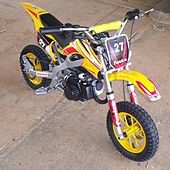
A two-stroke minibike

Lateral view of a two-stroke Forty series British Seagull outboard engine, the serial number dates it to 1954/1955
The two-stroke petrol engine was very popular throughout the 19th-20th century in motorcycles and small-engined devices, such as chainsaws and outboard motors, and was also used in some cars, a few tractors and many ships. Part of their appeal was their simple design (and resulting low cost) and often high power-to-weight ratio. The lower cost to rebuild and maintain made the two stroke engine incredibly popular, until for the USA their EPA mandated more stringent emission controls in 1978 (taking effect in 1980) and in 2004 (taking effect in 2005 and 2010). The industry largely responded by switching to four-stroke petrol engines, which emit less pollution.[1] Most small designs use petroil lubrication, with the oil being burned in the combustion chamber, causing "blue smoke" and other types of exhaust pollution. This is a major reason why two-stroke engines were replaced by four-stroke engines in many applications.
Two-stroke petrol (gas) engines continue to be commonly used in high-power, handheld applications such as string trimmers and chainsaws. The light overall weight, and light-weight spinning parts give important operational and even safety advantages. For example, a four-stroke engine to power a chainsaw operating in any position would be much more expensive and complex than a two-stroke engine that uses a gasoline-oil mixture.
These engines are still used for small, portable, or specialized machine applications such as outboard motors, high-performance, small-capacity motorcycles, mopeds, underbones, scooters, tuk-tuks, snowmobiles, karts, ultralights, model airplanes (and other model vehicles) and lawnmowers and dirt bikes.
The two-stroke cycle is also used in many diesel engines, most notably large industrial and marine engines, as well as some trucks and heavy machinery, but two-stroke diesels don't burn their lubricating oil and don't have the emission problems of two stroke petrol / gasoline engines.
A number of mainstream automobile manufacturers have used two-stroke engines in the past, including the Swedish Saab and German manufacturers DKW and Auto-Union. The Japanese manufacturer Suzuki did the same in the 1970s.[2] Production of two-stroke cars ended in the 1980s in the West, but Eastern Bloc countries continued until around 1991, with the Trabant and Wartburg in East Germany. Lotus of Norfolk, UK, has a prototype direct-injection two-stroke engine intended for alcohol fuels called the Omnivore[3][4] which it is demonstrating in a version of the Exige.[5] As this uses direct fuel injection it can be made not to use oil or crankcase compression, much like a 2T diesel.

Different two-stroke design types


A two-stroke engine, in this case with an expansion chamber illustrates the effect of a reflected pressure wave on the fuel charge. This feature is essential for maximum charge pressure (volumetric efficiency) and fuel efficiency. It is used on most high-performance engine designs.
Although the principles remain the same, the mechanical details of various two-stroke engines differ depending on the type. The design types vary according to the method of introducing the charge to the cylinder, the method of scavenging the cylinder (exchanging burnt exhaust for fresh mixture) and the method of exhausting the cylinder.

Piston-controlled inlet port

Piston port is the simplest of the designs and the most common in small 2 stroke motorcycles. All functions are controlled solely by the piston covering and uncovering the ports as it moves up and down in the cylinder. In the 1970s Yamaha worked out some basic principles for this system. They found that, in general, widening an exhaust port increases the power by the same amount as raising the port, but the power band does not narrow as it does when the port is raised. However, there is a mechanical limit to the width of a single exhaust port, at about 62% of the bore diameter for reasonable ring life. Beyond this, the rings will bulge into the exhaust port and wear quickly. A maximum is 70% of bore width is possible in racing engines, where rings are changed every few races. Intake duration is between 120 and 160 degrees. Transfer port time is set at a minimum of 26 degrees. The strong low pressure pulse of a racing 2-stroke expansion chamber can drop the pressure to -7 PSI when the piston is at bottom dead centre, and the transfer ports nearly wide open. One of the reasons for high gas consumption in 2-strokes is that some of the incoming pressurized fuel/air mixture is forced across the top of the piston, where it has a cooling action, and straight out the exhaust pipe. An expansion chamber with a strong reverse pulse will stop this out-going flow.[6] A fundamental difference from typical four-stroke engines is that the crankcase is sealed, and forms part of the induction process in gasoline and hot bulb engines. Diesel engines have mostly a Roots blower or piston pump for scavenging.

Reed inlet valve


A Cox Babe Bee 0.049 cubic inch (0.8 cubic cm) reed valve engine, disassembled, uses glow plug ignition. The mass is 64 grams.
The reed valve is a simple but highly effective form of check valve commonly fitted in the intake tract of the piston-controlled port. They allow asymmetric intake of the fuel charge, improving power and economy, while widening the power band. They are widely used in ATVs and marine outboard engines.

Rotary inlet valve

The intake pathway is opened and closed by a rotating member. A familiar type sometimes seen on small motorcycles is a slotted disk attached to the crankshaft which covers and uncovers an opening in the end of the crankcase, allowing charge to enter during one portion of the cycle.
Another form of rotary inlet valve used on two-stroke engines employs two cylindrical members with suitable cutouts arranged to rotate one within the other - the inlet pipe having passage to the crankcase only when the two cutouts coincide. The crankshaft itself may form one of the members, as in most glow plug model engines. In another embodiment, the crank disc is arranged to be a close-clearance fit in the crankcase, and is provided with a cutout which lines up with an inlet passage in the crankcase wall at the appropriate time, as in the Vespa motor scooter.
The advantage of a rotary valve is it enables the two-stroke engine's intake timing to be asymmetrical, which is not possible with piston port type engines. The piston port type engine's intake timing opens and closes before and after top dead center at the same crank angle, making it symmetrical, whereas the rotary valve allows the opening to begin earlier and close earlier.
Rotary valve engines can be tailored to deliver power over a wider speed range or higher power over a narrower speed range than either piston port or reed valve engine. Where a portion of the rotary valve is a portion of the crankcase itself, it is particularly important that no wear is allowed to take place.

Cross-flow-scavenged


Deflector piston with cross-flow scavenging
In a cross-flow engine, the transfer and exhaust ports are on opposite sides of the cylinder, and a deflector on the top of the piston directs the fresh intake charge into the upper part of the cylinder, pushing the residual exhaust gas down the other side of the deflector and out the exhaust port.[7] The deflector increases the piston's weight and exposed surface area, affecting piston cooling and also making it difficult to achieve an efficient combustion chamber shape. This design has been superseded since the 1960s by the loop scavenging method (below), especially for motorbikes, although for smaller or slower engines, such as motor mowers, the cross-flow-scavenged design can be an acceptable approach.

Loop-scavenged


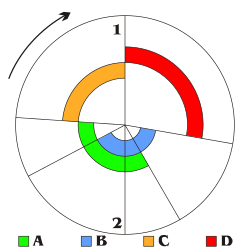
The Two-stroke cycle
1=TDC
2=BDC
 A: intake/scavenging 
 B: Exhaust 
 C: Compression 
 D: Expansion (power) 
This method of scavenging uses carefully shaped and positioned transfer ports to direct the flow of fresh mixture toward the combustion chamber as it enters the cylinder. The fuel/air mixture strikes the cylinder head, then follows the curvature of the combustion chamber, and then is deflected downward.
This not only prevents the fuel/air mixture from traveling directly out the exhaust port, but also creates a swirling turbulence which improves combustion efficiency, power and economy. Usually, a piston deflector is not required, so this approach has a distinct advantage over the cross-flow scheme (above).
Often referred to as "Schnuerle" (or "Schnürl") loop scavenging after the German inventor of an early form in the mid-1920s, it became widely adopted in that country during the 1930s and spread further afield after World War II.
Loop scavenging is the most common type of fuel/air mixture transfer used on modern two-stroke engines. Suzuki was one of the first manufacturers outside of Europe to adopt loop-scavenged two-stroke engines. This operational feature was used in conjunction with the expansion chamber exhaust developed by German motorcycle manufacturer, MZ and Walter Kaaden.
Loop scavenging, disc valves and expansion chambers worked in a highly coordinated way to significantly increase the power output of two-stroke engines, particularly from the Japanese manufacturers Suzuki, Yamaha and Kawasaki. Suzuki and Yamaha enjoyed success in grand Prix motorcycle racing in the 1960s due in no small way to the increased power afforded by loop scavenging.
An additional benefit of loop scavenging was the piston could be made nearly flat or slightly dome shaped, which allowed the piston to be appreciably lighter and stronger, and consequently to tolerate higher engine speeds. The "flat top" piston also has better thermal properties and is less prone to uneven heating, expansion, piston seizures, dimensional changes and compression losses.
SAAB built 750 and 850 cc 3-cylinder engines based on a DKW design that proved reasonably successful employing loop charging. The original SAAB 92 had a two-cylinder engine of comparatively low efficiency. At cruising speed, reflected wave exhaust port blocking occurred at too low a frequency. Using the asymmetric three-port exhaust manifold employed in the identical DKW engine improved fuel economy.
The 750 cc standard engine produced 36 to 42 hp, depending on the model year. The Monte Carlo Rally variant, 750 cc (with a filled crankshaft for higher base compression), generated 65 hp. An 850 cc version was available in the 1966 SAAB Sport (a standard trim model in comparison to the deluxe trim of the Monte Carlo). Base compression comprises a portion of the overall compression ratio of a two-stroke engine. Work published at SAE in 2012 points that loop scavenging is under every circumstance more efficient than uniflow scavenging.

Uniflow-scavenged


The Uniflow Two-stroke cycle
1=TDC (Diesel injection is usually initiated at 4° BTDC)
2=BDC
 A: Intake (effective scavenging ≈ 135°-225°; necessarily symmetric about BDC) 
 B: Exhaust (not necessarily symmetric) 
 C: Compression (not necessarily symmetric) 
 D: Expansion (power; not necessarily symmetric) 
In a uniflow engine, the mixture, or "charge air" in the case of a diesel, enters at one end of the cylinder controlled by the piston and the exhaust exits at the other end controlled by an exhaust valve or piston. The scavenging gas-flow is therefore in one direction only, hence the name uniflow. The valved arrangement is common in on-road, off-road and stationary two-stroke engines (Detroit Diesel), certain small marine two-stroke engines (Gray Marine), certain railroad two-stroke diesel locomotives (Electro-Motive Diesel) and large marine two-stroke main propulsion engines (Wärtsilä). Ported types are represented by the opposed piston design in which there are two pistons in each cylinder, working in opposite directions such as the Junkers Jumo and Napier Deltic.[8] The once-popular split-single design falls into this class, being effectively a folded uniflow. With advanced angle exhaust timing, uniflow engines can be supercharged with a crankshaft-driven (piston [9] or Roots) blower.
The latest invention, called the Reversed Uniflow two-stroke engine, has a large intake valve for compressed intake air without fuel-oil mixture. Direct fuel injection is to be used for gasoline or diesel fuel, pending intake air pressure. This engine will work on the Miller cycle. US Patent #6889636.

Stepped piston engine

The piston of this engine is "top-hat" shaped; the upper section forms the regular cylinder, and the lower section performs a scavenging function. The units run in pairs, with the lower half of one piston charging an adjacent combustion chamber.
This system is still partially dependent on total loss lubrication (for the upper part of the piston), the other parts being sump lubricated with cleanliness and reliability benefits. The piston weight is only about 20% heavier than a loop-scavenged piston because skirt thicknesses can be less. Bernard Hooper Engineering Ltd. (BHE) is one of the more recent engine developers using this approach.[10]

Power valve systems

Many modern two-stroke engines employ a power valve system. The valves are normally in or around the exhaust ports. They work in one of two ways: either they alter the exhaust port by closing off the top part of the port, which alters port timing, such as Ski-doo R.A.V.E, Yamaha YPVS, Honda RC-Valve, Kawasaki K.I.P.S., Cagiva C.T.S. or Suzuki AETC systems, or by altering the volume of the exhaust, which changes the resonant frequency of the expansion chamber, such as the Honda V-TACS system. The result is an engine with better low-speed power without sacrificing high-speed power. However as power valves are in the hot gas flow they need regular maintenance to perform well.

Direct injection

Direct injection has considerable advantages in two-stroke engines, eliminating some of the waste and pollution caused by carbureted two-strokes where a proportion of the fuel/air mixture entering the cylinder goes directly out, unburned, through the exhaust port. Two systems are in use, low-pressure air-assisted injection, and high pressure injection.
Since the fuel does not pass through the crankcase, a separate source of lubrication is needed.

Two-stroke diesel engine


Brons two-stroke V8 Diesel engine driving a Heemaf generator.
Diesel engines rely solely on the heat of compression for ignition. In the case of Schnuerle ported and loop-scavenged engines, intake and exhaust happens via piston-controlled ports. A uniflow diesel engine takes in air via scavenge ports, and exhaust gases exit through an overhead poppet valve. Two-stroke diesels are all scavenged by forced induction. Some designs use a mechanically driven Roots blower, whilst marine diesel engines normally use exhaust-driven turbochargers, with electrically-driven auxiliary blowers for low-speed operation when exhaust turbochargers are unable to deliver enough air.
Marine two-stroke diesel engines directly coupled to the propeller are able to start and run in either direction as required. The fuel injection and valve timing is mechanically readjusted by using a different set of cams on the camshaft. Thus, the engine can be run in reverse to move the vessel backwards.

Lubrication

Most small petrol two-stroke engines cannot be lubricated by oil contained in their crankcase and sump, since the crankcase is already being used to pump fuel-air mixture into the cylinder. Traditionally, the moving parts (both rotating crankshaft and sliding piston) were lubricated by a premixed fuel-oil mixture (at a ratio between 16:1 and 100:1). As late as the 1960s, petrol stations would often have a separate pump to deliver such a premix fuel to motorcycles. Even then, in many cases, the rider would carry a bottle of their own two-stroke oil. Taking care to close the fuel-tap first, he or she would meter in a little oil (using the cap of the bottle) and then put in the petrol, this action mixing the two liquids. Two-stroke oils which became available worldwide in the 1970s are specifically designed to mix with petrol and be burnt in the combustion chamber without leaving undue unburnt oil or ash. This led to a marked reduction in spark plug fouling, which had been a factor in two-stroke engines previously.
Modern two-stroke engines pump lubrication from a separate tank of two stroke oil. The supply of this oil is controlled by the throttle position. The technology is referred to as auto-lube. This is still a total-loss system with the oil being burnt the same as in the older system, but at a lower and more economical rate. It is also cleaner, reducing the problem of oil-fouling of the spark-plugs and coke formation in the cylinder and the exhaust. Two-stroke engines still using premix are hand-held two-stroke devices, such as chainsaws (which must operate in any attitude), the majority of model engines, British Seagull outboard motors, and some off-road motorcycles.
All two-stroke engines running on a petrol/oil mix will suffer oil starvation if forced to rotate at speed with the throttle closed, e.g. motorcycles descending long hills and perhaps when decelerating gradually from high speed by changing down through the gears. Two-stroke cars (such as those that were popular in Eastern Europe in mid-20th century) were in particular danger and were usually fitted with freewheel mechanisms in the powertrain, allowing the engine to idle when the throttle was closed, requiring the use of the brakes in all slowing situations.
Large two-stroke engines, including diesels, normally use a sump lubrication system similar to four-stroke engines. The cylinder must still be pressurized, but this is not done from the crankcase, but by an ancillary Roots-type blower or a specialized turbocharger (usually a turbo-compressor system) which has a "locked" compressor for starting (and during which it is powered by the engine's crankshaft), but which is "unlocked" for running (and during which it is powered by the engine's exhaust gases flowing through the turbine).

Two-stroke reversibility

For the purpose of this discussion, it is convenient to think in motorcycle terms, where the exhaust pipe faces into the cooling air stream, and the crankshaft commonly spins in the same axis and direction as do the wheels i.e. "forward". Some of the considerations discussed here apply to four-stroke engines (which cannot reverse their direction of rotation without considerable modification), almost all of which spin forward, too.
Regular gasoline two-stroke engines will run backwards for short periods and under light load with little problem, and this has been used to provide a reversing facility in microcars, such as the Messerschmitt KR200, that lacked reverse gearing. Where the vehicle has electric starting, the motor will be turned off and restarted backwards by turning the key in the opposite direction. Two-stroke golf carts have used a similar kind of system. Traditional flywheel magnetos (using contact-breaker points, but no external coil) worked equally well in reverse because the cam controlling the points is symmetrical, breaking contact before TDC equally well whether running forwards or backwards. Reed-valve engines will run backwards just as well as piston-controlled porting, though rotary valve engines have asymmetrical inlet timing and will not run very well.
There are serious disadvantages to running any engine backwards under load for any length of time, and some of these reasons are general, applying equally to both two-stroke and four-stroke engines. Some of this disadvantage is intrinsic, unavoidable even in the case of a complete re-design. The problem comes about because in "forwards" running the major thrust face of the piston is on the back face of the cylinder which, in a two-stroke particularly, is the coolest and best lubricated part. The forward face of the piston is less well-suited to be the major thrust face since it covers and uncovers the exhaust port in the cylinder, the hottest part of the engine, where piston lubrication is at its most marginal. The front face of the piston is also more vulnerable since the exhaust port, the largest in the engine, is in the front wall of the cylinder. Piston skirts and rings risk being extruded into this port, so it is always better to have them pressing hardest on the back wall (where there are only the transfer ports) and there is good support. In some engines, the small end is offset to reduce thrust in the intended rotational direction and the forward face of the piston has been made thinner and lighter to compensate - but when running backwards, this weaker forward face suffers increased mechanical stress it was not designed to resist.[11]
Large two-stroke ship diesels are sometimes made to be reversible. Like four-stroke ship engines (some of which are also reversible) they use mechanically-operated valves, so require additional camshaft mechanisms.
On top of other considerations, the oil-pump of a modern two-stroke may not work in reverse, in which case the engine will suffer oil starvation within a short time. Running a motorcycle engine backwards is relatively easy to initiate, and in rare cases, can be triggered by a back-fire. It is not advisable.
Model airplane engines with reed-valves can be mounted in either tractor or pusher configuration without needing to change the propeller. These motors are compression ignition, so there are no ignition timing issues and little difference between running forward and running backward.


ENGINE DIESEL SYSTEM

ENGINE DIESEL SYSTEMENGINE DIESEL SYSTEM [4-Stroke]
A diesel engine (also known as a compression-ignition engine) is an internal combustion engine that uses the heat of compression to initiate ignition to burn the fuel that has been injected into the combustion chamber. As opposed to spark-ignition engines such as a petrol engine (gasoline engine) or gas engine (using a gaseous fuel as opposed to gasoline), which uses a spark plug to ignite an air-fuel mixture. The engine was developed by German inventor Rudolf Diesel in 1893.
The diesel engine has the highest thermal efficiency of any standard internal or external combustion engine due to its very high compression ratio. Low-speed diesel engines (as used in ships and other applications where overall engine weight is relatively unimportant) can have a thermal efficiency that exceeds 50%.[1][2]
Diesel engines are manufactured in two-stroke and four-stroke versions. They were originally used as a more efficient replacement for stationary steam engines. Since the 1910s they have been used in submarines and ships. Use in locomotives, trucks, heavy equipment and electric generating plants followed later. In the 1930s, they slowly began to be used in a few automobiles. Since the 1970s, the use of diesel engines in larger on-road and off-road vehicles in the USA increased. According to the British Society of Motor Manufacturing and Traders, the EU average for diesel cars account for 50% of the total sold, including 70% in France and 38% in the UK.[3]
The world's largest diesel engine is currently a Wärtsilä-Sulzer RTA96-C Common Rail marine diesel of about 84,420 kW (113,210 hp) @ 102 rpm[4] output.[5]

History


Diesel's original 1897 engine on display at the Deutsches Museum in Munich, Germany
Rudolf Diesel was born in Paris in 1858 into a family of German expatriates.[6] He was educated at Munich Polytechnic. After graduation he was employed as a refrigerator engineer, but his true love lay in engine design. Diesel designed many heat engines, including a solar-powered air engine. In 1892 he received patents in Germany, Switzerland, the United Kingdom and filed in the United States for "Method of and Apparatus for Converting Heat into Work".[7] In 1893 he described a "slow-combustion engine" that first compressed air thereby raising its temperature above the igniting-point of the fuel, then gradually introducing fuel while letting the mixture expand "against resistance sufficiently to prevent an essential increase of temperature and pressure", then cutting off fuel and "expanding without transfer of heat".[citation needed] In 1894 and 1895 he filed patents and addenda in various countries for his Diesel engine; the first patents were issued in Spain (No. 16,654), France (No. 243,531) and Belgium (No. 113,139) in December 1894, and in Germany (No. 86,633) in 1895 and the United States (No. 608,845) in 1898.[8] He operated his first successful engine in 1897.
Though best known for his invention of the pressure-ignited heat engine that bears his name, Rudolf Diesel was also a well-respected thermal engineer and a social theorist. Diesel's inventions have three points in common: they relate to heat transfer by natural physical processes or laws; they involve markedly creative mechanical design; and they were initially motivated by the inventor's concept of sociological needs. Rudolf Diesel originally conceived the diesel engine to enable independent craftsmen and artisans to compete with industry.[9]
At Augsburg, on August 10, 1893, Rudolf Diesel's prime model, a single 10-foot (3.0 m) iron cylinder with a flywheel at its base, ran on its own power for the first time. Diesel spent two more years making improvements and in 1896 demonstrated another model with a theoretical efficiency of 75%, in contrast to the 10% efficiency of the steam engine. By 1898, Diesel had become a millionaire. His engines were used to power pipelines, electric and water plants, automobiles and trucks, and marine craft. They were soon to be used in mines, oil fields, factories, and transoceanic shipping.

History timeline


Rudolf Diesel
1890s
  • 1892: February 23, Rudolf Diesel obtained a patent (RP 67207) titled "Arbeitsverfahren und Ausführungsart für Verbrennungsmaschinen".
  • 1893: Diesel's essay titled Theory and Construction of a Rational Heat-engine to Replace the Steam Engine and Combustion Engines Known Today appeared.
  • 1893: August 10, Diesel built his first working prototype in Augsburg.[10]
  • 1897: Adolphus Busch licenses rights to the Diesel Engine for the USA and Canada.[10]
  • 1898 Diesel licensed his engine to Branobel, a Russian oil company interested in an engine that could consume non-distilled oil. Branobel's engineers spent four years designing a ship-mounted engine.
  • 1899: Diesel licensed his engine to builders Krupp and Sulzer, who quickly became major manufacturers.
1900s
  • 1902: Until 1910 MAN produced 82 copies of the stationary diesel engine.
  • 1903: Two first diesel-powered ships were launched, both for river and canal operations: Petite-Pierre in France, powered by Dyckhoff-built diesels, and Vandal tanker in Russia, powered by Swedish-built diesels with an electrical transmission.
  • 1904: The French built the first diesel submarine, the Z.
  • 1905: Four diesel engine turbochargers and intercoolers were manufactured by Büchl (CH), as well as a scroll-type supercharger from Creux (F) company.
  • 1908: Prosper L'Orange and Deutz developed a precisely controlled injection pump with a needle injection nozzle.
  • 1909: The prechamber with a hemispherical combustion chamber was developed by Prosper L'Orange with Benz.
1910s
  • 1910: The Norwegian research ship Fram was a sailing ship fitted with an auxiliary diesel engine, and was thus the first ocean-going ship with a diesel engine.[11]
  • 1912: The Danish built the first ocean-going ship exclusively powered by a diesel engine, MS Selandia.[11] The first locomotive with a diesel engine also appeared.
  • 1913: U.S. Navy submarines used NELSECO units. Rudolf Diesel died mysteriously when he crossed the English Channel on the SS Dresden.
  • 1914: German U-boats were powered by MAN diesels.
  • 1919: Prosper L'Orange obtained a patent on a prechamber insert and made a needle injection nozzle. First diesel engine from Cummins.
1920s
  • 1921: Prosper L'Orange built a continuous variable output injection pump.
  • 1922: The first vehicle with a (pre-chamber) diesel engine was Agricultural Tractor Type 6 of the Benz Söhne agricultural tractor OE Benz Sendling.
  • 1923: The first truck with pre-chamber diesel engine made by MAN and Benz. Daimler-Motoren-Gesellschaft testing the first air-injection diesel-engined truck.
  • 1924: The introduction on the truck market of the diesel engine by commercial truck manufacturers in the IAA. Fairbanks-Morse starts building diesel engines.
  • 1927: First truck injection pump and injection nozzles of Bosch. First passenger car prototype of Stoewer.
1930s
  • 1930s: Caterpillar started building diesels for their tractors.
  • 1930: First US diesel-power passenger car (Cummins powered Packard) built in Columbus, Indiana (USA)[12]
  • 1930: Beardmore Tornado diesel engines power the British airship R101
  • 1932: Introduction of the strongest diesel truck in the world by MAN with 160 hp (120 kW).
  • 1933: First European passenger cars with diesel engines (Citroën Rosalie); Citroën used an engine of the English diesel pioneer Sir Harry Ricardo.[13] The car did not go into production due to legal restrictions on the use of diesel engines.
  • 1934: First turbo diesel engine for a railway train by Maybach. First streamlined, stainless steel passenger train in the US, the Pioneer Zephyr, using a Winton engine.
  • 1934: First tank equipped with diesel engine, the Polish 7TP.
  • 1934–35: Junkers Motorenwerke in Germany started production of the Jumo aviation diesel engine family, the most famous of these being the Jumo 205, of which over 900 examples were produced by the outbreak of World War II.

    Rudolf Diesel's 1893 patent on his engine design
  • 1936: Mercedes-Benz built the 260D diesel car.[14] AT&SF inaugurated the diesel train Super Chief. The airship Hindenburg was powered by diesel engines. First series of passenger cars manufactured with diesel engine (Mercedes-Benz 260 D, Hanomag and Saurer). Daimler Benz airship diesel engine 602LOF6 for the LZ129 Hindenburg airship.
  • 1937: The Soviet Union chose a diesel engine for its T-34 tank, widely regarded as the best tank chassis of World War II.
  • 1937: BMW 114 experimental airplane diesel engine development.
  • 1938: First turbo diesel engine of Saurer.
1940s
1950s
1960s
1970s
  • 1973: DAF produced an air-cooled diesel engine.
  • 1976 February: Tested a diesel engine for the Volkswagen Golf passenger car. The Cummins Common Rail injection system was further developed by the ETH Zurich from 1976 to 1992.
  • 1978: Mercedes produced the first passenger car turbo-diesels (Mercedes 300 SD).[14]
  • 1978: Oldsmobile introduced the first passenger car diesel engine produced by an American car company.
1980s
  • 1985: ATI Intercooler diesel engine from DAF. European Truck Common Rail system with the IFA truck type W50 introduced.
  • 1986: Electronic Diesel Control (EDC) of Bosch with the BMW 524tD.
  • 1986: The Fiat Croma was the first passenger car in the world to have a direct injection turbodiesel engine in (1986).[18]
  • 1987: Most powerful production truck with a 460 hp (340 kW) MAN diesel engine.
1990s
  • 1991: European emission standards Euro 1 met with the truck diesel engine of Scania.
  • 1993: Pump nozzle injection introduced in Volvo truck engines.
  • 1994: Unit injector system by Bosch for diesel engines.
  • 1995: First successful use of common rail in a production vehicle, by Denso in Japan, Hino "Rising Ranger" truck.
  • 1997: First common rail in passenger car, Alfa Romeo 156.[19]
  • 1998: BMW made history by winning the 24 Hour Nürburgring race with the 320d, powered by a two-litre, four-cylinder diesel engine. The combination of high-performance with better fuel efficiency allowed the team to make fewer pit stops during the long endurance race.
  • 1999: Euro 3 of Scania and the first common rail truck diesel engine of Renault.
2000s
  • 2002: A street-driven Dodge Dakota pickup with a 735 horsepower (548 kW) diesel engine built at Gale banks engineering hauls its own service trailer to the Bonneville Salt Flats and set an FIA land speed record as the world's fastest pickup truck with a one-way run of 222 mph (357 km/h) and a two-way average of 217 mph (349 km/h).
  • 2004: In Western Europe, the proportion of passenger cars with diesel engine exceeded 50%. Selective catalytic reduction (SCR) system in Mercedes, Euro 4 with EGR system and particle filters of MAN. Piezoelectric injector technology by Bosch.
  • 2006: Audi R10 TDI won 12 hours running in Sebring and defeated all other engine concepts. The same car won the 2006 24 Hours of Le Mans. Euro 5 for all Iveco trucks.
  • 2006: JCB Dieselmax broke the FIA Diesel Land speed record from 1973, eventually setting the new record at over 350 mph (563 km/h).
  • 2008: Subaru introduced the first horizontally opposed diesel engine to be fitted to a passenger car. This is a Euro 5 compliant engine with an EGR system.
  • 2009: Volkswagen won the 2009 Dakar Rally held in Argentina and Chile. The first diesel to do so. Race Touareg 2 finished 1st and 2nd.
  • 2009: Volvo claimed the world's strongest truck with their FH16 700. An inline 6-cylinder, 16 L (976 cu in) 700 hp (522 kW) diesel engine producing 3150 Nm (2323.32 lb•ft) of torque and fully complying with Euro 5 emission standards.[20]
2010s
  • 2010: Mitsubishi developed and started mass production of its 4N13 1.8 L DOHC I4, the world's first passenger car diesel engine that features a variable valve timing system.[21][22]
  • 2010: Scania AB's V8 had the highest torque and power ratings of any truck engine: 730 hp (544 kW) and 3,500 N·m (2,581 ft·lb).[23]

How diesel engines work


p-V Diagram for the Ideal Diesel cycle. The cycle follows the numbers 1-4 in clockwise direction. In the diesel cycle the combustion occurs at almost constant pressure and the exhaust occurs at constant volume. On this diagram the work that is generated for each cycle corresponds to the area within the loop.

Diesel engine model, left side

Diesel engine model, right side
The diesel internal combustion engine differs from the gasoline powered Otto cycle by using highly compressed hot air to ignite the fuel rather than using a spark plug (compression ignition rather than spark ignition).
In the true diesel engine, only air is initially introduced into the combustion chamber. The air is then compressed with a compression ratio typically between 15:1 and 22:1 resulting in 40-bar (4.0 MPa; 580 psi) pressure compared to 8 to 14 bars (0.80 to 1.4 MPa; 120 to 200 psi) in the petrol engine. This high compression heats the air to 550 °C (1,022 °F). At about the top of the compression stroke, fuel is injected directly into the compressed air in the combustion chamber. This may be into a (typically toroidal) void in the top of the piston or a pre-chamber depending upon the design of the engine. The fuel injector ensures that the fuel is broken down into small droplets, and that the fuel is distributed evenly. The heat of the compressed air vaporizes fuel from the surface of the droplets. The vapour is then ignited by the heat from the compressed air in the combustion chamber, the droplets continue to vaporise from their surfaces and burn, getting smaller, until all the fuel in the droplets has been burnt. The start of vaporisation causes a delay period during ignition and the characteristic diesel knocking sound as the vapour reaches ignition temperature and causes an abrupt increase in pressure above the piston. The rapid expansion of combustion gases then drives the piston downward, supplying power to the crankshaft.[24]
As well as the high level of compression allowing combustion to take place without a separate ignition system, a high compression ratio greatly increases the engine's efficiency. Increasing the compression ratio in a spark-ignition engine where fuel and air are mixed before entry to the cylinder is limited by the need to prevent damaging pre-ignition. Since only air is compressed in a diesel engine, and fuel is not introduced into the cylinder until shortly before top dead centre (TDC), premature detonation is not an issue and compression ratios are much higher.

Early fuel injection systems

Diesel's original engine injected fuel with the assistance of compressed air, which atomized the fuel and forced it into the engine through a nozzle (a similar principle to an aerosol spray). The nozzle opening was closed by a pin valve lifted by the camshaft to initiate the fuel injection before top dead centre (TDC). This is called an air-blast injection. Driving the three stage compressor used some power but the efficiency and net power output was more than any other combustion engine at that time.
Diesel engines in service today raise the fuel to extreme pressures by mechanical pumps and deliver it to the combustion chamber by pressure-activated injectors without compressed air. With direct injected diesels, injectors spray fuel through 4 to 12 small orifices in its nozzle. The early air injection diesels always had a superior combustion without the sharp increase in pressure during combustion. Research is now being performed and patents are being taken out to again use some form of air injection to reduce the nitrogen oxides and pollution, reverting to Diesel's original implementation with its superior combustion and possibly quieter operation. In all major aspects, the modern diesel engine holds true to Rudolf Diesel's original design, that of igniting fuel by compression at an extremely high pressure within the cylinder. With much higher pressures and high technology injectors, present-day diesel engines use the so-called solid injection system applied by Herbert Akroyd Stuart for his hot bulb engine. The indirect injection engine could be considered the latest development of these low speed hot bulb ignition engines.

Fuel delivery

A vital component of all diesel engines is a mechanical or electronic governor which regulates the idling speed and maximum speed of the engine by controlling the rate of fuel delivery. Unlike Otto-cycle engines, incoming air is not throttled and a diesel engine without a governor cannot have a stable idling speed and can easily overspeed, resulting in its destruction. Mechanically governed fuel injection systems are driven by the engine's gear train.[25] These systems use a combination of springs and weights to control fuel delivery relative to both load and speed.[25] Modern electronically controlled diesel engines control fuel delivery by use of an electronic control module (ECM) or electronic control unit (ECU). The ECM/ECU receives an engine speed signal, as well as other operating parameters such as intake manifold pressure and fuel temperature, from a sensor and controls the amount of fuel and start of injection timing through actuators to maximise power and efficiency and minimise emissions. Controlling the timing of the start of injection of fuel into the cylinder is a key to minimizing emissions, and maximizing fuel economy (efficiency), of the engine. The timing is measured in degrees of crank angle of the piston before top dead centre. For example, if the ECM/ECU initiates fuel injection when the piston is 10° before TDC, the start of injection, or timing, is said to be 10° BTDC. Optimal timing will depend on the engine design as well as its speed and load.
Advancing the start of injection (injecting before the piston reaches to its SOI-TDC) results in higher in-cylinder pressure and temperature, and higher efficiency, but also results in elevated engine noise and increased oxides of nitrogen (NOx) emissions due to higher combustion temperatures. Delaying start of injection causes incomplete combustion, reduced fuel efficiency and an increase in exhaust smoke, containing a considerable amount of particulate matter and unburned hydrocarbons.

Major advantages

Diesel engines have several advantages over other internal combustion engines:
  • They burn less fuel than a petrol engine performing the same work, due to the engine's higher temperature of combustion and greater expansion ratio.[1] Gasoline engines are typically 30% efficient while diesel engines can convert over 45% of the fuel energy into mechanical energy[26] (see Carnot cycle for further explanation).
  • They have no high voltage electrical ignition system, resulting in high reliability and easy adaptation to damp environments. The absence of coils, spark plug wires, etc., also eliminates a source of radio frequency emissions which can interfere with navigation and communication equipment, which is especially important in marine and aircraft applications.
  • The life of a diesel engine is generally about twice as long as that of a petrol engine[27][better source needed] due to the increased strength of parts used. Diesel fuel has better lubrication properties than petrol as well.

Bus powered by biodiesel
  • Diesel fuel is distilled directly from petroleum. Distillation yields some gasoline, but the yield would be inadequate without catalytic reforming, which is a more costly process.
  • Diesel fuel is considered safer than petrol in many applications. Although diesel fuel will burn in open air using a wick, it will not explode and does not release a large amount of flammable vapor. The low vapor pressure of diesel is especially advantageous in marine applications, where the accumulation of explosive fuel-air mixtures is a particular hazard. For the same reason, diesel engines are immune to vapor lock.
  • For any given partial load the fuel efficiency (mass burned per energy produced) of a diesel engine remains nearly constant, as opposed to petrol and turbine engines which use proportionally more fuel with partial power outputs.[28][29][30][31]
  • They generate less waste heat in cooling and exhaust.[1]
  • Diesel engines can accept super- or turbo-charging pressure without any natural limit, constrained only by the strength of engine components. This is unlike petrol engines, which inevitably suffer detonation at higher pressure.
  • The carbon monoxide content of the exhaust is minimal, therefore diesel engines are used in underground mines.[32]
  • Biodiesel is an easily synthesized, non-petroleum-based fuel (through transesterification) which can run directly in many diesel engines, while gasoline engines either need adaptation to run synthetic fuels or else use them as an additive to gasoline (e.g., ethanol added to gasohol).

Mechanical and electronic injection

Many configurations of fuel injection have been used over the course of the 20th century.
Most present-day diesel engines use a mechanical single plunger high-pressure fuel pump driven by the engine crankshaft. For each engine cylinder, the corresponding plunger in the fuel pump measures out the correct amount of fuel and determines the timing of each injection. These engines use injectors that are very precise spring-loaded valves that open and close at a specific fuel pressure. Separate high-pressure fuel lines connect the fuel pump with each cylinder. Fuel volume for each single combustion is controlled by a slanted groove in the plunger which rotates only a few degrees releasing the pressure and is controlled by a mechanical governor, consisting of weights rotating at engine speed constrained by springs and a lever. The injectors are held open by the fuel pressure. On high-speed engines the plunger pumps are together in one unit.[33] The length of fuel lines from the pump to each injector is normally the same for each cylinder in order to obtain the same pressure delay.
A cheaper configuration on high-speed engines with fewer than six cylinders is to use an axial-piston distributor pump, consisting of one rotating pump plunger delivering fuel to a valve and line for each cylinder (functionally analogous to points and distributor cap on an Otto engine).[25]
Many modern systems have a single fuel pump which supplies fuel constantly at high pressure with a common rail (single fuel line common) to each injector. Each injector has a solenoid operated by an electronic control unit, resulting in more accurate control of injector opening times that depend on other control conditions, such as engine speed and loading, and providing better engine performance and fuel economy.[citation needed]
Both mechanical and electronic injection systems can be used in either direct or indirect injection configurations.[citation needed]
Two-stroke diesel engines with mechanical injection pumps can be inadvertently run in reverse, albeit in a very inefficient manner, possibly damaging the engine.[citation needed] Large ship two-stroke diesels are designed to run in either direction, obviating the need for a gearbox.[citation needed]

Indirect injection


Arrow indicates opening from pre-chamber
An indirect injection diesel engine delivers fuel into a chamber off the combustion chamber, called a pre-chamber or ante-chamber, where combustion begins and then spreads into the main combustion chamber, assisted by turbulence created in the chamber. This system allows for a smoother, quieter running engine, and because combustion is assisted by turbulence, injector pressures can be lower, about 100 bar (10 MPa; 1,500 psi), using a single orifice tapered jet injector. Mechanical injection systems allowed high-speed running suitable for road vehicles (typically up to speeds of around 4,000 rpm. The pre-chamber had the disadvantage of increasing heat loss to the engine's cooling system, and restricting the combustion burn, which reduced the efficiency by 5–10%.[34] Indirect injection engines are cheaper to build and it is easier to produce smooth, quiet-running vehicles with a simple mechanical system. In road-going vehicles most prefer the greater efficiency and better controlled emission levels of direct injection. Indirect injection diesels can still be found in the many ATV diesel applications.[citation needed]

Direct injection

Direct injection diesel engines have injectors mounted at the top of the combustion chamber. The injectors are activated using one of two methods - hydraulic pressure from the fuel pump, or an electronic signal from an engine controller.
Hydraulic pressure activated injectors can produce harsh engine noise. Fuel consumption is about 15–20% lower than indirect injection diesels. The extra noise is generally not a problem for industrial uses of the engine, but for automotive usage, buyers have to decide whether or not the increased fuel efficiency would compensate for the extra noise.
Electronic control of the fuel injection transformed the direct injection engine by allowing much greater control over the combustion.[35]

Unit direct injection

Unit direct injection also injects fuel directly into the cylinder of the engine. In this system the injector and the pump are combined into one unit positioned over each cylinder controlled by the camshaft. Each cylinder has its own unit eliminating the high-pressure fuel lines, achieving a more consistent injection. This type of injection system, also developed by Bosch, is used by Volkswagen AG in cars (where it is called a Pumpe-Düse-System—literally pump-nozzle system) and by Mercedes Benz ("PLD") and most major diesel engine manufacturers in large commercial engines (CAT, Cummins, Detroit Diesel, Electro-Motive Diesel, Volvo). With recent advancements, the pump pressure has been raised to 2,400 bars (240 MPa; 35,000 psi),[36] allowing injection parameters similar to common rail systems.[37]

Common rail direct injection

In common rail systems, the separate pulsing high-pressure fuel line to each cylinder's injector is also eliminated. Instead, a high-pressure pump pressurizes fuel at up to 2,500 bar (250 MPa; 36,000 psi),[38] in a "common rail". The common rail is a tube that supplies each computer-controlled injector containing a precision-machined nozzle and a plunger driven by a solenoid or piezoelectric actuator.

Cold weather

Starting

In cold weather, high speed diesel engines can be difficult to start because the mass of the cylinder block and cylinder head absorb the heat of compression, preventing ignition due to the higher surface-to-volume ratio. Pre-chambered engines make use of small electric heaters inside the pre-chambers called glowplugs, while the direct-injected engines have these glowplugs in the combustion chamber.[citation needed]
Many engines use resistive heaters in the intake manifold to warm the inlet air for starting, or until the engine reaches operating temperature. Engine block heaters (electric resistive heaters in the engine block) connected to the utility grid are used in cold climates when an engine is turned off for extended periods (more than an hour), to reduce startup time and engine wear. Block heaters are also used for emergency power standby Diesel-powered generators which must rapidly pick up load on a power failure. In the past, a wider variety of cold-start methods were used. Some engines, such as Detroit Diesel[39] engines used[when?] a system to introduce small amounts of ether into the inlet manifold to start combustion. Others used a mixed system, with a resistive heater burning methanol. An impromptu method, particularly on out-of-tune engines, is to manually spray an aerosol can of ether-based engine starter fluid into the intake air stream (usually through the intake air filter assembly).

Gelling

Diesel fuel is also prone to waxing or gelling in cold weather; both are terms for the solidification of diesel oil into a partially crystalline state. The crystals build up in the fuel line (especially in fuel filters), eventually starving the engine of fuel and causing it to stop running. Low-output electric heaters in fuel tanks and around fuel lines are used to solve this problem. Also, most engines have a spill return system, by which any excess fuel from the injector pump and injectors is returned to the fuel tank. Once the engine has warmed, returning warm fuel prevents waxing in the tank.
Due to improvements in fuel technology with additives, waxing rarely occurs in all but the coldest weather when a mix of diesel and kerosene may be used to run a vehicle. Gas stations in regions with a cold climate are required to offer winterized diesel in the cold seasons that allow operation below a specific Cold Filter Plugging Point. In Europe these diesel characteristics are described in the EN 590 standard.

Types

Size Groups


Two Cycle Diesel engine with Roots blower, typical of Detroit Diesel and some Electro-Motive Diesel Engines
There are three size groups of Diesel engines[40]
  • Small - Under 188 kW (252 hp) output
  • Medium
  • Large

Basic Types of Diesel Engines

There are two basic types of Diesel Engines[40]
  • Four Cycle
  • Two Cycle

Early

Rudolf Diesel based his engine on the design of the Gas engine created by Nikolaus Otto in 1876 with the goal of improving its efficiency. He patented his Diesel engine concepts in patents that were set forth in 1892 and 1893.[41] As such, diesel engines in the late 19th and early 20th centuries used the same basic layout and form as industrial steam engines, with long-bore cylinders, external valve gear, cross-head bearings and an open crankshaft connected to a large flywheel.[dubious ] Smaller engines would be built with vertical cylinders, while most medium- and large-sized industrial engines were built with horizontal cylinders, just as steam engines had been. Engines could be built with more than one cylinder in both cases. The largest early diesels resembled the triple-expansion steam reciprocating engine, being tens of feet high with vertical cylinders arranged in-line. These early engines ran at very slow speeds—partly due to the limitations of their air-blast injector equipment and partly so they would be compatible with the majority of industrial equipment designed for steam engines; maximum speeds of 100–300 rpm were common. Engines were usually started by allowing compressed air into the cylinders to turn the engine, although smaller engines could be started by hand.[42]
In 1897 when the first Diesel engine was completed Adolphus Busch traveled to Cologne and negotiated exclusive right to produce the Diesel engine in the USA and Canada. In his examination of the engine it was noted that the Diesel at that time operated at efficiencies of 32–35% thermodynamic efficiency when a typical triple expansion steam engine would operate at about 18%.[10]
In the early decades of the 20th century, when large diesel engines were first being used, the engines took a form similar to the compound steam engines common at the time, with the piston being connected to the connecting rod by a crosshead bearing. Following steam engine practice some manufacturers made double-acting two-stroke and four-stroke diesel engines to increase power output, with combustion taking place on both sides of the piston, with two sets of valve gear and fuel injection. While it produced large amounts of power and was very efficient, the double-acting diesel engine's main problem was producing a good seal where the piston rod passed through the bottom of the lower combustion chamber to the crosshead bearing, and no more were built. By the 1930s turbochargers were fitted to some engines. Crosshead bearings are still used to reduce the wear on the cylinders in large long-stroke main marine engines.

Modern High- and Medium-speed Engines


A Yanmar 2GM20 marine diesel engine, installed in a sailboat
As with petrol engines, there are two classes of diesel engines in current use: two-stroke and four-stroke. The four-stroke type is the "classic" version, tracing its lineage back to Rudolf Diesel's prototype. It is also the most commonly used form, being the preferred power source for many motor vehicles, especially buses and trucks. Much larger engines, such as used for railroad locomotion and marine propulsion, are often two-stroke units, offering a more favourable power-to-weight ratio, as well as better fuel economy. The most powerful engines in the world are two-stroke diesels of mammoth dimensions.[43]
Two-stroke diesel engine operation is similar to that of petrol counterparts, except that fuel is not mixed with air before induction, and the crankcase does not take an active role in the cycle. The traditional two-stroke design relies upon a mechanically driven positive displacement blower to charge the cylinders with air before compression and ignition. The charging process also assists in expelling (scavenging) combustion gases remaining from the previous power stroke.
The archetype of the modern form of the two-stroke diesel is the (high-speed) Detroit Diesel Series 71 engine, designed by Charles F. "Boss" Kettering and his colleagues at General Motors Corporation in 1938, in which the blower pressurizes a chamber in the engine block that is often referred to as the "air box". The (very much larger medium-speed) Electro-Motive Diesel engine[44] is used as the prime mover in EMD diesel-electric locomotive, marine and stationary applications, and was designed by the same team, and is built to the same principle. However, a significant improvement built into most later EMD engines is the mechanically-assisted turbo-compressor, which provides charge air using mechanical assistance during starting (thereby obviating the necessity for Roots-blown scavenging), and provides charge air using an exhaust gas-driven turbine during normal operations—thereby providing true turbocharging and additionally increasing the engine's power output by at least fifty percent.[a]
In a two-stroke diesel engine, as the cylinder's piston approaches the bottom dead centre exhaust ports or valves are opened relieving most of the excess pressure after which a passage between the air box and the cylinder is opened, permitting air flow into the cylinder.[45][46] The air flow blows the remaining combustion gases from the cylinder—this is the scavenging process. As the piston passes through bottom centre and starts upward, the passage is closed and compression commences,[47] culminating in fuel injection and ignition.[48] Refer to two-stroke diesel engines for more detailed coverage of aspiration types and supercharging of two-stroke diesel engines.
Normally, the number of cylinders are used in multiples of two, although any number of cylinders can be used as long as the load on the crankshaft is counterbalanced to prevent excessive vibration. The inline-six-cylinder design is the most prolific in light- to medium-duty engines, though small V8 and larger inline-four displacement engines are also common. Small-capacity engines (generally considered to be those below five litres in capacity) are generally four- or six-cylinder types, with the four-cylinder being the most common type found in automotive uses. Five-cylinder diesel engines have also been produced, being a compromise between the smooth running of the six-cylinder and the space-efficient dimensions of the four-cylinder. Diesel engines for smaller plant machinery, boats, tractors, generators and pumps may be four-, three- or two-cylinder types, with the single-cylinder diesel engine remaining for light stationary work. Direct reversible two-stroke marine diesels need at least three cylinders for reliable restarting forwards and reverse, while four-stroke diesels need at least six cylinders.
The desire to improve the diesel engine's power-to-weight ratio produced several novel cylinder arrangements to extract more power from a given capacity. The uniflow opposed-piston engine uses two pistons in one cylinder with the combustion cavity in the middle and gas in- and outlets at the ends. This makes a comparatively light, powerful, swiftly running and economic engine suitable for use in aviation. An example is the Junkers Jumo 204/205. The Napier Deltic engine, with three cylinders arranged in a triangular formation, each containing two opposed pistons, the whole engine having three crankshafts, is one of the better known.

Modern Low-speed Engines

Low-speed diesel engines (as used in ships and other applications where overall engine weight is relatively unimportant) often have a thermal efficiency which exceeds 50%.[1][2]

Gas generator

Before 1950, Sulzer started experimenting with two-stroke engines with boost pressures as high as 6 atmospheres, in which all the output power was taken from an exhaust gas turbine. The two-stroke pistons directly drove air compressor pistons to make a positive displacement gas generator. Opposed pistons were connected by linkages instead of crankshafts. Several of these units could be connected to provide power gas to one large output turbine. The overall thermal efficiency was roughly twice that of a simple gas turbine.[49] This system was derived from Raúl Pateras Pescara's work on free-piston engines in the 1930s.

Advantages and disadvantages versus spark-ignition engines

Power and fuel economy

The MAN S80ME-C7 low speed diesel engines use 155 grams (5.5 oz) of fuel per kWh for an overall energy conversion efficiency of 54.4%, which is the highest conversion of fuel into power by any single-cycle internal or external combustion engine[1] (The efficiency of a combined cycle gas turbine system can exceed 60%.[50]) Diesel engines are more efficient than gasoline (petrol) engines of the same power rating, resulting in lower fuel consumption. A common margin is 40% more miles per gallon for an efficient turbodiesel. For example, the current model Škoda Octavia, using Volkswagen Group engines, has a combined Euro rating of 6.2 L/100 km (46 mpg-imp; 38 mpg-US) for the 102 bhp (76 kW) petrol engine and 4.4 L/100 km (64 mpg-imp; 53 mpg-US) for the 105 bhp (78 kW) diesel engine.
However, such a comparison does not take into account that diesel fuel is denser and contains about 15% more energy by volume. Although the calorific value of the fuel is slightly lower at 45.3 MJ/kg (megajoules per kilogram) than petrol at 45.8 MJ/kg, liquid diesel fuel is significantly denser than liquid petrol. This is significant because volume of fuel, in addition to mass, is an important consideration in mobile applications. No vehicle has an unlimited volume available for fuel storage.
Adjusting the numbers to account for the energy density of diesel fuel, the overall energy efficiency is still about 20% greater for the diesel version.
While a higher compression ratio is helpful in raising efficiency, diesel engines are much more efficient than gasoline (petrol) engines when at low power and at engine idle. Unlike the petrol engine, diesels lack a butterfly valve (throttle) in the inlet system, which closes at idle. This creates parasitic loss and destruction of availability of the incoming air, reducing the efficiency of petrol engines at idle. In many applications, such as marine, agriculture, and railways, diesels are left idling and unattended for many hours, sometimes even days. These advantages are especially attractive in locomotives (see dieselisation).
The average diesel engine has a poorer power-to-weight ratio than the petrol engine. This is because the diesel must operate at lower engine speeds[51] and because it needs heavier, stronger parts to resist the operating pressure caused by the high compression ratio of the engine and the large amounts of torque generated to the crankshaft. In addition, diesels are often built with stronger parts to give them longer lives and better reliability, important considerations in industrial applications.
For most industrial or nautical applications, reliability is considered more important than light weight and high power. Diesel fuel is injected just before the power stroke. As a result, the fuel cannot burn completely unless it has a sufficient amount of oxygen. This can result in incomplete combustion and black smoke in the exhaust if more fuel is injected than there is air available for the combustion process. Modern engines with electronic fuel delivery can adjust the timing and amount of fuel delivery (by changing the duration of the injection pulse), and so operate with less waste of fuel. In a mechanical system, the injection timing and duration must be set to be efficient at the anticipated operating rpm and load, and so the settings are less than ideal when the engine is running at any other RPM than what it is timed for. The electronic injection can "sense" engine revs, load, even boost and temperature, and continuously alter the timing to match the given situation. In the petrol engine, air and fuel are mixed for the entire compression stroke, ensuring complete mixing even at higher engine speeds.
Diesel engines usually have longer stroke lengths chiefly to facilitate achieving the necessary compression ratios, but also to reduce the optimal operating speed (rpm). As a result piston and connecting rods are heavier and more force must be transmitted through the connecting rods and crankshaft to change the momentum of the piston. This is another reason that a diesel engine must be stronger for the same power output as a petrol engine.
Yet it is this characteristic that has allowed some enthusiasts to acquire significant power increases with turbocharged engines by making fairly simple and inexpensive modifications. A petrol engine of similar size cannot put out a comparable power increase without extensive alterations because the stock components cannot withstand the higher stresses placed upon them. Since a diesel engine is already built to withstand higher levels of stress, it makes an ideal candidate for performance tuning at little expense. However, it should be said that any modification that raises the amount of fuel and air put through a diesel engine will increase its operating temperature, which will reduce its life and increase service requirements. These are issues with newer, lighter, high-performance diesel engines which are not "overbuilt" to the degree of older engines and they are being pushed to provide greater power in smaller engines.
The addition of a turbocharger or supercharger to the engine greatly assists in increasing fuel economy and power output, mitigating the fuel-air intake speed limit mentioned above for a given engine displacement. Boost pressures can be higher on diesels than on petrol engines, due to the latter's susceptibility to knock, and the higher compression ratio allows a diesel engine to be more efficient than a comparable spark ignition engine. Because the burned gases are expanded further in a diesel engine cylinder, the exhaust gas is cooler, meaning turbochargers require less cooling, and can be more reliable, than with spark-ignition engines.
Without the risk of knocking, boost pressure in a diesel engine can be much higher; it is possible to run as much boost as the engine will physically stand before breaking apart.
The increased fuel economy of the diesel engine over the petrol engine means that the diesel produces less carbon dioxide (CO2) per unit distance. Recent advances in production and changes in the political climate have increased the availability and awareness of biodiesel, an alternative to petroleum-derived diesel fuel with a much lower net-sum emission of CO2, due to the absorption of CO2 by plants used to produce the fuel. Although concerns are now being raised as to the negative effect this is having on the world food supply, as the growing of crops specifically for biofuels takes up land that could be used for food crops and uses water that could be used by both humans and animals. However, the use of waste vegetable oil, sawmill waste from managed forests in Finland, and advances in the production of vegetable oil from algae demonstrate great promise in providing feed stocks for sustainable biodiesel that are not in competition with food production.
A combination of improved mechanical technology (such as multi-stage injectors which fire a short "pilot charge" of fuel into the cylinder to warm the combustion chamber before delivering the main fuel charge), higher injection pressures that have improved the atomisation of fuel into smaller droplets, and electronic control (which can adjust the timing and length of the injection process to optimise it for all speeds and temperatures) have mitigated most of these problems in the latest generation of common-rail designs, while greatly improving engine efficiency. Poor power and narrow torque bands have been addressed by superchargers, turbochargers, (especially variable geometry turbochargers), intercoolers, and a large efficiency increase from about 35% for IDI to 45% for the latest engines in the last 15 years.[citation needed]
Even though diesel engines have a theoretical fuel efficiency of 75%,[citation needed] in practice it is lower. Engines in large diesel trucks, buses, and newer diesel cars can achieve peak efficiencies around 45%,[52] and could reach 55% efficiency in the near future.[53] However, average efficiency over a driving cycle is lower than peak efficiency. For example, it might be 37% for an engine with a peak efficiency of 44%.[54]

Emissions

In diesel engines, conditions in the engine differ from the spark-ignition engine, since power is directly controlled by the fuel supply, rather than by controlling the air supply. Thus when the engine runs at low power, there is enough oxygen present to burn the fuel, and diesel engines only make significant amounts of carbon monoxide when running under a load.
Diesel exhaust is well known for its characteristic smell; but this smell in recent years has become much less because the sulfur is now removed from the fuel in the oil refinery.
Diesel exhaust has been found to contain a long list of toxic air contaminants. Among these pollutants, fine particle pollution is perhaps the most important as a cause of diesel's harmful health effects.

Power and torque

For commercial uses requiring towing, load carrying and other tractive tasks, diesel engines tend to have better torque characteristics than petrol engines. Diesel engines tend to have their torque peak quite low in their speed range (usually between 1600 and 2000 rpm for a small-capacity unit, lower for a larger engine used in a truck). This provides smoother control over heavy loads when starting from rest, and, crucially, allows the diesel engine to be given higher loads at lower speeds than a petrol engine, making them much more economical for these applications. This characteristic is not so desirable in private cars, so most modern diesels used in such vehicles use electronic control, variable geometry turbochargers and shorter piston strokes to achieve a wider spread of torque over the engine's speed range, typically peaking at around 2500–3000 rpm.
While diesel engines tend to have more torque at lower engine speeds than petrol engines, diesel engines tend to have a narrower power band than petrol engines. Naturally aspirated diesels tend to lack power and torque at the top of their speed range. This narrow band is a reason why a vehicle such as a truck may have a gearbox with as many as 18 or more gears, to allow the engine's power to be used effectively at all speeds. Turbochargers tend to improve power at high engine speeds; superchargers improve power at lower speeds; and variable geometry turbochargers improve the engine's performance equally by flattening the torque curve. The Paxman Hi-Dyne engine was a 1950s attempt to widen the power band of a diesel engine.

Noise

The characteristic noise of a diesel engine is variably called diesel clatter, diesel nailing, or diesel knock.[55] Diesel clatter is caused largely by the diesel combustion process; the sudden ignition of the diesel fuel when injected into the combustion chamber causes a pressure wave. Engine designers can reduce diesel clatter through: indirect injection; pilot or pre-injection; injection timing; injection rate; compression ratio; turbo boost; and exhaust gas recirculation (EGR).[56] Common rail diesel injection systems permit multiple injection events as an aid to noise reduction. Diesel fuels with a higher cetane rating modify the combustion process and reduce diesel clatter.[55] CN (Cetane number) can be raised by distilling higher quality crude oil, by catalyzing a higher quality product or by using a cetane improving additive.[citation needed]
A combination of improved mechanical technology such as multi-stage injectors which fire a short "pilot charge" of fuel into the cylinder to initiate combustion before delivering the main fuel charge, higher injection pressures that have improved the atomisation of fuel into smaller droplets, and electronic control (which can adjust the timing and length of the injection process to optimise it for all speeds and temperatures), have partially mitigated these problems in the latest generation of common-rail designs, while improving engine efficiency.[citation needed]

Reliability

The lack of an electrical ignition system greatly improves the reliability. The high durability of a diesel engine is also due to its overbuilt nature (see above), a benefit that is magnified by the lower rotating speeds in diesels. Diesel fuel is a better lubricant than petrol so is less harmful to the oil film on piston rings and cylinder bores; it is routine for diesel engines to cover 400,000 km (250,000 mi) or more without a rebuild.
Due to the greater compression ratio and the increased weight of the stronger components, starting a diesel engine is harder than starting a gasoline engine of similar design and displacement. More torque[clarification needed] is required to push the engine through compression.[citation needed]
Either an electrical starter or an air-start system is used to start the engine turning. On large engines, pre-lubrication and slow turning of an engine, as well as heating, are required to minimise the amount of engine damage during initial start-up and running. Some smaller military diesels can be started with an explosive cartridge, called a Coffman starter, which provides the extra power required to get the machine turning. In the past, Caterpillar and John Deere used a small petrol pony engine in their tractors to start the primary diesel engine. The pony engine heated the diesel to aid in ignition and used a small clutch and transmission to spin up the diesel engine. Even more unusual was an International Harvester design in which the diesel engine had its own carburetor and ignition system, and started on petrol. Once warmed up, the operator moved two levers to switch the engine to diesel operation, and work could begin. These engines had very complex cylinder heads, with their own petrol combustion chambers, and were vulnerable to expensive damage if special care was not taken (especially in letting the engine cool before turning it off).[citation needed]

Quality and variety of fuels

Petrol/gasoline engines are limited in the variety and quality of the fuels they can burn. Older petrol engines fitted with a carburetor required a volatile fuel that would vaporise easily to create the necessary air-fuel ratio for combustion. Because both air and fuel are admitted to the cylinder, if the compression ratio of the engine is too high or the fuel too volatile (with too low an octane rating), the fuel will ignite under compression, as in a diesel engine, before the piston reaches the top of its stroke. This pre-ignition causes a power loss and over time major damage to the piston and cylinder. The need for a fuel that is volatile enough to vaporise but not too volatile (to avoid pre-ignition) means that petrol engines will only run on a narrow range of fuels. There has been some success at dual-fuel engines that use petrol and ethanol, petrol and propane, and petrol and methane.
In diesel engines, a mechanical injector system vaporizes the fuel directly into the combustion chamber or a pre-combustion chamber (as opposed to a Venturi jet in a carburetor, or a fuel injector in a fuel injection system vaporising fuel into the intake manifold or intake runners as in a petrol engine). This forced vaporisation means that less-volatile fuels can be used. More crucially, because only air is inducted into the cylinder in a diesel engine, the compression ratio can be much higher as there is no risk of pre-ignition provided the injection process is accurately timed. This means that cylinder temperatures are much higher in a diesel engine than a petrol engine, allowing less volatile fuels to be used.
Diesel fuel is a form of light fuel oil, very similar to kerosene (paraffin), but diesel engines, especially older or simple designs that lack precision electronic injection systems, can run on a wide variety of other fuels. Some of the most common alternatives are Jet A-1 type jet fuel or vegetable oil from a very wide variety of plants. Some engines can be run on vegetable oil without modification, and most others require fairly basic alterations. Biodiesel is a pure diesel-like fuel refined from vegetable oil and can be used in nearly all diesel engines. Requirements for fuels to be used in diesel engines are the ability of the fuel to flow along the fuel lines, the ability of the fuel to lubricate the injector pump and injectors adequately, and its ignition qualities (ignition delay, cetane number). Inline mechanical injector pumps generally tolerate poor-quality or bio-fuels better than distributor-type pumps. Also, indirect injection engines generally run more satisfactorily on bio-fuels than direct injection engines. This is partly because an indirect injection engine has a much greater 'swirl' effect, improving vaporisation and combustion of fuel, and because (in the case of vegetable oil-type fuels) lipid depositions can condense on the cylinder walls of a direct-injection engine if combustion temperatures are too low (such as starting the engine from cold).
It is often reported that Diesel designed his engine to run on peanut oil, but this is false. Patent number 608845 describes his engine as being designed to run on pulverulent solid fuel (coal dust). Diesel stated in his published papers, "at the Paris Exhibition in 1900 (Exposition Universelle) there was shown by the Otto Company a small diesel engine, which, at the request of the French Government ran on Arachide (earth-nut or peanut) oil (see biodiesel), and worked so smoothly that only a few people were aware of it. The engine was constructed for using mineral oil, and was then worked on vegetable oil without any alterations being made. The French Government at the time thought of testing the applicability to power production of the Arachide, or earth-nut, which grows in considerable quantities in their African colonies, and can easily be cultivated there." Diesel himself later conducted related tests and appeared supportive of the idea.[57]
Most large marine diesels run on heavy fuel oil (sometimes called "bunker oil"), which is a thick, viscous and almost flameproof fuel which is very safe to store and cheap to buy in bulk as it is a waste product from the petroleum refining industry. The fuel must be heated to thin it out (often by the exhaust header) and is often passed through multiple injection stages to vaporise it.[citation needed]

Fuel and fluid characteristics

Diesel engines can operate on a variety of different fuels, depending on configuration, though the eponymous diesel fuel derived from crude oil is most common. The engines can work with the full spectrum of crude oil distillates, from natural gas, alcohols, petrol, wood gas to the fuel oils from diesel oil to residual fuels.[58]
The type of fuel used is a combination of service requirements, and fuel costs. Good-quality diesel fuel can be synthesised from vegetable oil and alcohol. Diesel fuel can be made from coal or other carbon base using the Fischer-Tropsch process. Biodiesel is growing in popularity since it can frequently be used in unmodified engines, though production remains limited. Recently, biodiesel from coconut, which can produce a very promising coco methyl ester (CME), has characteristics which enhance lubricity and combustion giving a regular diesel engine without any modification more power, less particulate matter or black smoke, and smoother engine performance. The Philippines pioneers in the research on Coconut based CME with the help of German and American scientists. Petroleum-derived diesel is often called petrodiesel if there is need to distinguish the source of the fuel.
Pure plant oils are increasingly being used as a fuel for cars, trucks and remote combined heat and power generation especially in Germany where hundreds of decentralised small- and medium-sized oil presses cold press oilseed, mainly rapeseed, for fuel. There is a Deutsches Institut für Normung fuel standard for rapeseed oil fuel.
Residual fuels are the "dregs" of the distillation process and are a thicker, heavier oil, or oil with higher viscosity, which are so thick that they are not readily pumpable unless heated. Residual fuel oils are cheaper than clean, refined diesel oil, although they are dirtier. Their main considerations are for use in ships and very large generation sets, due to the cost of the large volume of fuel consumed, frequently amounting to many tonnes per hour. The poorly refined biofuels straight vegetable oil (SVO) and waste vegetable oil (WVO) can fall into this category, but can be viable fuels on non-common rail or TDI PD diesels with the simple conversion of fuel heating to 80 to 100 degrees Celsius to reduce viscosity, and adequate filtration to OEM standards. Engines using these heavy oils have to start and shut down on standard diesel fuel, as these fuels will not flow through fuel lines at low temperatures. Moving beyond that, use of low-grade fuels can lead to serious maintenance problems because of their high sulphur and lower lubrication properties. Most diesel engines that power ships like supertankers are built so that the engine can safely use low-grade fuels due to their separate cylinder and crankcase lubrication.
Normal diesel fuel is more difficult to ignite and slower in developing fire than petrol because of its higher flash point, but once burning, a diesel fire can be fierce.
Fuel contaminants such as dirt and water are often more problematic in diesel engines than in petrol engines. Water can cause serious damage, due to corrosion, to the injection pump and injectors; and dirt, even very fine particulate matter, can damage the injection pumps due to the close tolerances that the pumps are machined to. All diesel engines will have a fuel filter (usually much finer than a filter on a petrol engine), and a water trap. The water trap (which is sometimes part of the fuel filter) often has a float connected to a warning light, which warns when there is too much water in the trap, and must be drained before damage to the engine can result. The fuel filter must be replaced much more often on a diesel engine than on a petrol engine, changing the fuel filter every 2-4 oil changes is not uncommon for some vehicles.

Safety

Fuel flammability

Diesel fuel has low flammability, leading to a low risk of fire caused by fuel in a vehicle equipped with a diesel engine.
In yachts diesels are used because petrol engines generate combustible vapors, which can accumulate in the bottom of the vessel, sometimes causing explosions. Therefore ventilation systems on petrol powered vessels are required.[59]
The United States Army and NATO use only diesel engines and turbines because of fire hazard. Although neither gasoline nor diesel is explosive in liquid form, both can create an explosive air/vapor mix under the right conditions. However, diesel fuel is less prone due to its lower vapor pressure, which is an indication of evaporation rate. The Material Safety Data Sheet[60] for ultra-low sulfur diesel fuel indicates a vapor explosion hazard for diesel indoors, outdoors, or in sewers.
US Army gasoline-engined tanks during World War II were nicknamed Ronsons, because of their greater likelihood of catching fire when damaged by enemy fire. (Although tank fires were usually caused by detonation of the ammunition rather than fuel).

Maintenance hazards

Fuel injection introduces potential hazards in engine maintenance due to the high fuel pressures used. Residual pressure can remain in the fuel lines long after an injection-equipped engine has been shut down. This residual pressure must be relieved, and if it is done so by external bleed-off, the fuel must be safely contained. If a high-pressure diesel fuel injector is removed from its seat and operated in open air, there is a risk to the operator of injury by hypodermic jet-injection, even with only 100 psi pressure.[61] The first known such injury occurred in 1937 during a diesel engine maintenance operation.[62]

Cancer

Diesel exhaust has been classified as an IARC Group 1 carcinogen. It is a cause of lung cancer and is associated with an increased risk for bladder cancer.[63]

Diesel applications

The characteristics of diesel have different advantages for different applications.

Passenger cars

Diesel engines have long been popular in bigger cars and have been used in smaller cars such as superminis like the Peugeot 205, in Europe since the 1980s. Diesel engines tend to be more economical at regular driving speeds and are much better at city speeds. Their reliability and life-span tend to be better (as detailed). Some 40% or more of all cars sold in Europe are diesel-powered where they are considered a low CO2 option. Mercedes-Benz in conjunction with Robert Bosch GmbH produced diesel-powered passenger cars starting in 1936 and very large numbers are used all over the world (often as "Grande Taxis" in the Third World).

Railroad rolling stock

Diesel engines have eclipsed steam engines as the prime mover on all non-electrified railroads in the industrialized world. The first diesel locomotives appeared in the early 20th century, and diesel multiple units soon after.
While electric locomotives have now replaced the diesel locomotive almost completely on passenger traffic in Europe and Asia, diesel is still today very popular for cargo-hauling freight trains and on tracks where electrification is not feasible.
Most modern diesel locomotives are actually diesel-electric locomotives: the diesel engine is used to power an electric generator that in turn powers electric traction motors with no mechanical connection between diesel engine and traction.
After 2000, environmental requirements has caused higher development cost for engines, and it has become common for passenger multiple units to use engines and automatic mechanical gearboxes made for trucks. Up to four such combinations might be used to get enough power in a train.

Other transport uses

Larger transport applications (trucks, buses, etc.) also benefit from the Diesel's reliability and high torque output. Diesel displaced paraffin (or tractor vaporising oil, TVO) in most parts of the world by the end of the 1950s with the U.S. following some 20 years later.
In merchant ships and boats, the same advantages apply with the relative safety of Diesel fuel an additional benefit. The German pocket battleships were the largest Diesel warships, but the German torpedo-boats known as E-boats (Schnellboot) of the Second World War were also Diesel craft. Conventional submarines have used them since before World War I, relying on the almost total absence of carbon monoxide in the exhaust. American World War II Diesel-electric submarines operated on two-stroke cycle, as opposed to the four-stroke cycle that other navies used.

Military fuel standardisation

NATO has a single vehicle fuel policy and has selected diesel for this purpose. The use of a single fuel simplifies wartime logistics. NATO and the United States Marine Corps have even been developing a diesel military motorcycle based on a Kawasaki off road motorcycle, with a purpose designed naturally aspirated direct injection diesel at Cranfield University in England, to be produced in the USA, because motorcycles were the last remaining gasoline-powered vehicle in their inventory. Before this, a few civilian motorcycles had been built using adapted stationary diesel engines, but the weight and cost disadvantages generally outweighed the efficiency gains.

Non-transport uses


A 1944 V12 2,300 kW power plant undergoing testing & restoration
Diesel engines are also used to power permanent, portable, and backup generators, irrigation pumps,[64] corn grinders,[65] and coffee de-pulpers.[66]

Engine speeds

Within the diesel engine industry, engines are often categorized by their rotational speeds into three unofficial groups:
  • High-speed engines (> 1,000 rpm),
  • medium-speed engines (300 - 1,000 rpm), and
  • slow-speed engines (< 300 rpm).
High- and medium-speed engines are predominantly four-stroke engines; except for the Detroit Diesel two-stroke range. Medium-speed engines are physically larger than high-speed engines and can burn lower-grade (slower-burning) fuel than high-speed engines. Slow-speed engines are predominantly large two-stroke crosshead engines, hence very different from high- and medium-speed engines. Due to the lower rotational speed of slow- and medium-speed engines, there is more time for combustion during the power stroke of the cycle, allowing the use of slower-burning fuels than high-speed engines.

High-speed engines

High-speed (approximately 1,000 rpm and greater) engines are used to power trucks (lorries), buses, tractors, cars, yachts, compressors, pumps and small electrical generators. As of 2008, most high-speed engines have direct injection. Many modern engines, particularly in on-highway applications, have common rail direct injection, which is cleaner burning.

Medium-speed engines

Medium-speed engines are used in large electrical generators, ship propulsion and mechanical drive applications such as large compressors or pumps. Medium speed diesel engines operate on either diesel fuel or heavy fuel oil by direct injection in the same manner as low-speed engines.
Engines used in electrical generators run at approximately 300 to 1000 rpm and are optimized to run at a set synchronous speed depending on the generation frequency (50 or 60 hertz) and provide a rapid response to load changes. Typical synchronous speeds for modern medium-speed engines are 500/514 rpm (50/60 Hz), 600 rpm (both 50 and 60 Hz), 720/750 rpm, and 900/1000 rpm.
As of 2009, the largest medium-speed engines in current production have outputs up to approximately 20 MW (27,000 hp). and are supplied by companies like MAN B&W, Wärtsilä,[67] and Rolls-Royce (who acquired Ulstein Bergen Diesel in 1999). Most medium-speed engines produced are four-stroke machines, however there are some two-stroke medium-speed engines such as by EMD (Electro-Motive Diesel), and the Fairbanks Morse OP (Opposed-piston engine) type.
Typical cylinder bore size for medium-speed engines ranges from 20 cm to 50 cm, and engine configurations typically are offered ranging from in-line 4-cylinder units to V-configuration 20-cylinder units. Most larger medium-speed engines are started with compressed air direct on pistons, using an air distributor, as opposed to a pneumatic starting motor acting on the flywheel, which tends to be used for smaller engines. There is no definitive engine size cut-off point for this.
It should also be noted that most major manufacturers of medium-speed engines make natural gas-fueled versions of their diesel engines, which in fact operate on the Otto cycle, and require spark ignition, typically provided with a spark plug.[58] There are also dual (diesel/natural gas/coal gas) fuel versions of medium and low speed diesel engines using a lean fuel air mixture and a small injection of diesel fuel (so-called "pilot fuel") for ignition. In case of a gas supply failure or maximum power demand these engines will instantly switch back to full diesel fuel operation.[58][68][69]

Low-speed engines


The MAN B&W 5S50MC 5-cylinder, 2-stroke, low-speed marine diesel engine. This particular engine is found aboard a 29,000 tonne chemical carrier.
Also known as slow-speed, or traditionally oil engines, the largest diesel engines are primarily used to power ships, although there are a few land-based power generation units as well. These extremely large two-stroke engines have power outputs up to approximately 85 MW (114,000 hp), operate in the range from approximately 60 to 200 rpm and are up to 15 m (50 ft) tall, and can weigh over 2,000 short tons (1,800 t). They typically use direct injection running on cheap low-grade heavy fuel, also known as Bunker C fuel, which requires heating in the ship for tanking and before injection due to the fuel's high viscosity. Often, the waste heat recovery steam boilers attached to the engine exhaust ducting generate the heat required for fuel heating. Provided the heavy fuel system is kept warm and circulating, engines can be started and stopped on heavy fuel.
Large and medium marine engines are started with compressed air directly applied to the pistons. Air is applied to cylinders to start the engine forwards or backwards because they are normally directly connected to the propeller without clutch or gearbox, and to provide reverse propulsion either the engine must be run backwards or the ship will utilise an adjustable propeller. At least three cylinders are required with two-stroke engines and at least six cylinders with four-stroke engines to provide torque every 120 degrees.
Companies such as MAN B&W Diesel, (formerly Burmeister & Wain) and Wärtsilä (which acquired Sulzer Diesel) design such large low-speed engines. They are unusually narrow and tall due to the addition of a crosshead bearing. As of 2007, the 14-cylinder Wärtsilä-Sulzer 14RTFLEX96-C turbocharged two-stroke diesel engine built by Wärtsilä licensee Doosan in Korea is the most powerful diesel engine put into service, with a cylinder bore of 960 mm (37.8 in) delivering 114,800 hp (85.6 MW). It was put into service in September 2006, aboard the world's largest container ship Emma Maersk which belongs to the A.P. Moller-Maersk Group. Typical bore size for low-speed engines ranges from approximately 35 to 98 cm (14 to 39 in). As of 2008, all produced low-speed engines with crosshead bearings are in-line configurations; no Vee versions have been produced.

Supercharging and turbocharging

Most diesels are now turbocharged and some are both turbo charged and supercharged. Because diesels do not have fuel in the cylinder before combustion is initiated, more than one bar (100 kPa) of air can be loaded in the cylinder without preignition. A turbocharged engine can produce significantly more power than a naturally aspirated engine of the same configuration, as having more air in the cylinders allows more fuel to be burned and thus more power to be produced. A supercharger is powered mechanically by the engine's crankshaft, while a turbocharger is powered by the engine exhaust, not requiring any mechanical power. Turbocharging can improve the fuel economy[70] of diesel engines by recovering waste heat from the exhaust, increasing the excess air factor, and increasing the ratio of engine output to friction losses.
A two-stroke engine does not have a discrete exhaust and intake stroke and thus is incapable of self-aspiration. Therefore all two-stroke engines must be fitted with a blower to charge the cylinders with air and assist in dispersing exhaust gases, a process referred to as scavenging. In some cases, the engine may also be fitted with a turbocharger, whose output is directed into the blower inlet. A few designs employ a hybrid turbocharger for scavenging and charging the cylinders, which device is mechanically driven at cranking and low speeds to act as a blower.
As turbocharged or supercharged engines produce more power for a given engine size as compared to naturally aspirated engines, attention must be paid to the mechanical design of components, lubrication, and cooling to handle the power. Pistons are usually cooled with lubrication oil sprayed on the bottom of the piston. Large engines may use water, sea water, or oil supplied through telescoping pipes attached to the crosshead.[71]

Current and future developments

As of 2008, many common rail and unit injection systems already employ new injectors using stacked piezoelectric wafers in lieu of a solenoid, giving finer control of the injection event.[72]
Variable geometry turbochargers have flexible vanes, which move and let more air into the engine depending on load. This technology increases both performance and fuel economy. Boost lag is reduced as turbo impeller inertia is compensated for.[73]
Accelerometer pilot control (APC) uses an accelerometer to provide feedback on the engine's level of noise and vibration and thus instruct the ECU to inject the minimum amount of fuel that will produce quiet combustion and still provide the required power (especially while idling).[74]
The next generation of common rail diesels is expected to use variable injection geometry, which allows the amount of fuel injected to be varied over a wider range, and variable valve timing (see Mitsubishi's 4N13 diesel engine) similar to that on petrol engines. Particularly in the United States, coming tougher emissions regulations present a considerable challenge to diesel engine manufacturers. Ford's HyTrans Project has developed a system which starts the ignition in 400 ms, saving a significant amount of fuel on city routes, and there are other methods to achieve even more efficient combustion, such as homogeneous charge compression ignition, being studied.[75][76]
Japanese and Swedish vehicle manufacturers are also developing diesel engines that run on dimethyl ether (DME).[77] [78]
Some recent diesel engine models utilize a copper alloy heat exchanger technology (CuproBraze) to take advantage of benefits in terms of thermal performance, heat transfer efficiency, strength/durability, corrosion resistance, and reduced emissions from higher operating temperatures.

ENGINE DIESEL SYSTEM [2-Stroke]
It may surprise you to learn that the biggest diesel engines in use operate on the two stroke principle. If you have experience of the two stroke petrol engine you will know that it causes more pollution than a four stroke petrol engine. This is because oil is mixed with the petrol to lubricate the crankshaft bearings, and a lot of unburnt petrol/oil/air mixture is discharged to the atmosphere. To learn more about the 2 stroke petrol engine cycle click here.
The two stroke Diesel engine does not mix fuel or oil with the combustion air. The crankshaft bearings are lubricated from pressurised oil in the same way as a four stroke engine.
The two stroke cycle is so called because it takes two strokes of the piston to complete the processes needed to convert the energy in the fuel into work. Because the engine is reciprocating, this means that the piston must move up and down the cylinder, and therefore the crankshaft must revolve once.

1. The crankshaft is revolving clockwise and the piston is moving up the cylinder, compressing the charge of air. Because energy is being transferred into the air, its pressure and temperature increase. By the time the piston is approaching the top of the cylinder (known as Top Dead Center or TDC) the pressure is over 100 bar and the temperature over 500°C

2. Just before TDC fuel is injected into the cylinder by the fuel injector. The  fuel is "atomised" into tiny droplets. Because they are very small these droplets heat up very quickly and start to burn as the piston passes over TDC. The expanding gas from the fuel burning in the oxygen forces the piston down the cylinder, turning the crankshaft. It is during this stroke that work energy is being put into the engine; during the upward stroke of the piston, the engine is having to do the work.

3. As the piston moves down the cylinder, the useful energy from the burning fuel is expended. At about 110° after TDC the exhaust valve opens and the hot exhaust gas  (consisting mostly of nitrogen, carbon dioxide, water vapour and unused oxygen)  begin to leave the cylinder.

4. At about 140º after TDC the piston uncovers a set of ports known as scavenge ports. Pressurised air enters the cylinder via these ports and pushes the remaining exhaust gas from the cylinder in a process known as "scavenging".
The piston now goes past Bottom Dead Centre and starts moving up the cylinder, closing off the scavenge ports. The exhaust valve then closes and compression begins


The two stroke cycle can also be illustrated on a timing diagram.
1 -2 Compression
2 - 3 Fuel Injection
3 - 4 Power
4 - 5 Exhaust Blowdown
5 - 6 Scavenging
6 - 1 Post Scavenging
1. approx 110º BTDC
2. approx 10º BTDC
3. approx 12º ATDC
4. approx 110º ATDC
5. approx 140º ATDC
6. approx 140º BTDC

In the 2 stroke trunk piston engine, the side thrust caused by the angularity of the connecting rod is transmitted to the liner by the piston skirt or trunk. It is therefore known as a 2 Stroke Trunk Piston Engine. The skirt of the piston also acts to seal the scavenge air ports when the engine is at TDC. This prevents the scavenge air from pressurising the crankcase.
Herein lies the disadvantage of this type of engine: although it has a low overall height, lubricating oil splashed up from the crankcase to lubricate the liner can find its way into the scavenge space, causing fouling and a risk of a scavenge fire. There is also the likelihood of liner and piston skirt wear, allowing air into the crankcase. This can supply the required oxygen for a crankcase explosion should a hot spot develop. The crankcase oil must have additives which can cope with contamination from products of combustion, and the acids formed during combustion due to the sulphur in the fuel.
This design of two stroke is generally only used for the smaller lower powered 2 stroke engines - up to about 5000kW for a V16 engine with a 280mm bore and 320mm stroke.
Detroit diesels manufacture 2 stroke trunk piston engines as do Wichmann and General Motors. Sulzer used to produce a model which is sometimes found at sea as did Brons. A cross sectional drawing of their type GV engine is shown below.